Chicago’s Strike Reaches Hilton and Hyatt: What It Means for Your Labor Budget
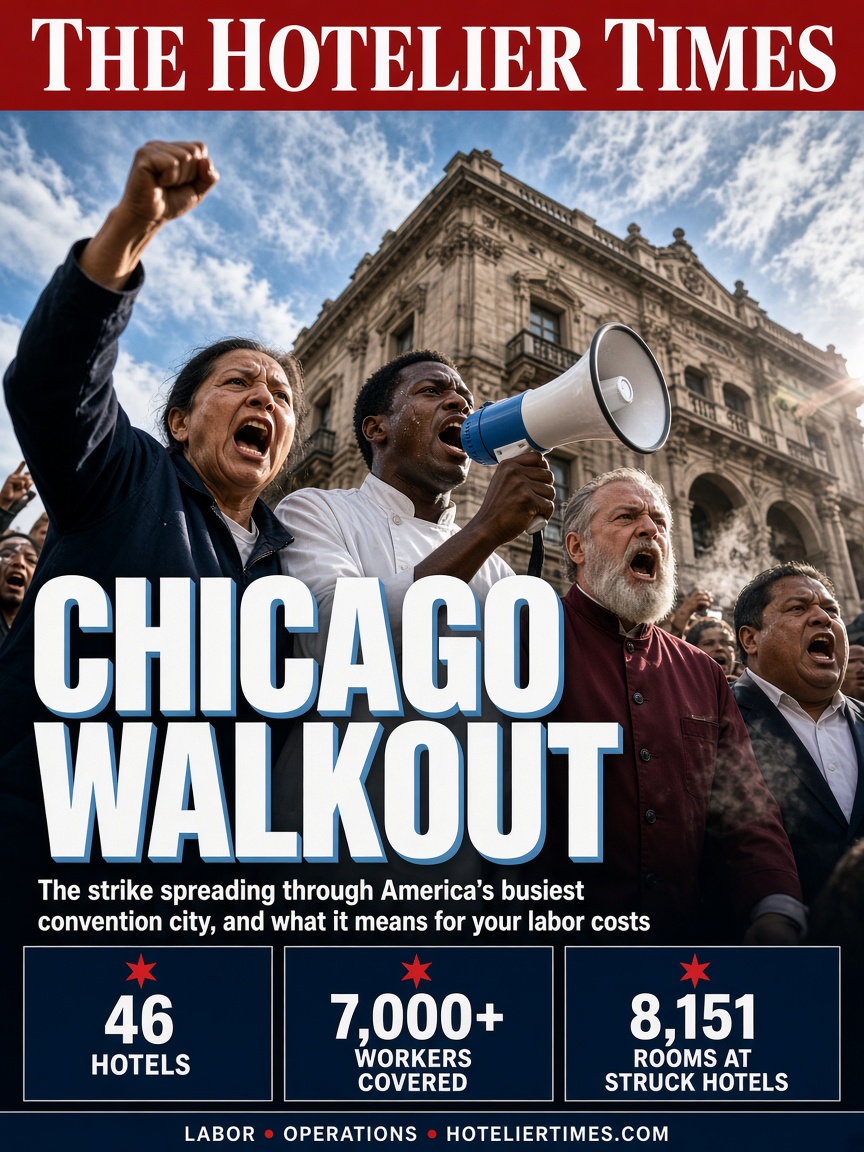
Eight of the 46 Chicago hotels whose workers authorized a strike are now on the picket line, including two of downtown’s best-known convention hotels. The wage number that settles this will not stay in Chicago, and it will land on owners’ P&Ls, not the brands’.
Less than a month ago we wrote that Chicago’s strike vote was a price-discovery event, not a local dispute. It has now moved from a vote to a walkout, and the walkout is getting bigger.
On Sunday, Oct. 18, hundreds of UNITE HERE Local 1 members walked off the job at the Hilton Chicago on South Michigan Avenue and the Hyatt Regency Chicago on East Wacker Drive, according to CBS Chicago and Hotel Dive. They joined workers at six hotels who struck on Oct. 9, two days before the Chicago Marathon: the Sheraton Grand Chicago Riverwalk, Waldorf Astoria Chicago, Palmer House a Hilton Hotel, The Westin Chicago River North, The Westin Michigan Avenue Chicago and the Millennium Hotel Knickerbocker.
The Numbers So Far
- 7,000+ workers at 46 hotels are covered by the dispute.
- 85% voted to authorize a strike in September.
- Aug. 31: the day contracts expired at 44 of the 46 hotels, per Skift. The other two also lack a contract.
- 8 hotels have been struck since Oct. 9, with about 8,151 rooms between them, based on Choose Chicago’s hotel supply list. We could not confirm how many of the six Oct. 9 hotels are still out.
- $22.3 billion: what the union says Marriott, Hilton and Hyatt returned to shareholders over three years.
The 7,000 figure counts workers covered by the expired contracts, not strikers; Hotel Dive and WTTW describe “hundreds” on the picket lines. Hotel Dive notes that if every worker who authorized the strike walked out, it would be the largest hotel strike in Chicago history. The union has warned more workers “could be on strike at any moment.”
Why the Hilton and Hyatt Walkouts Matter
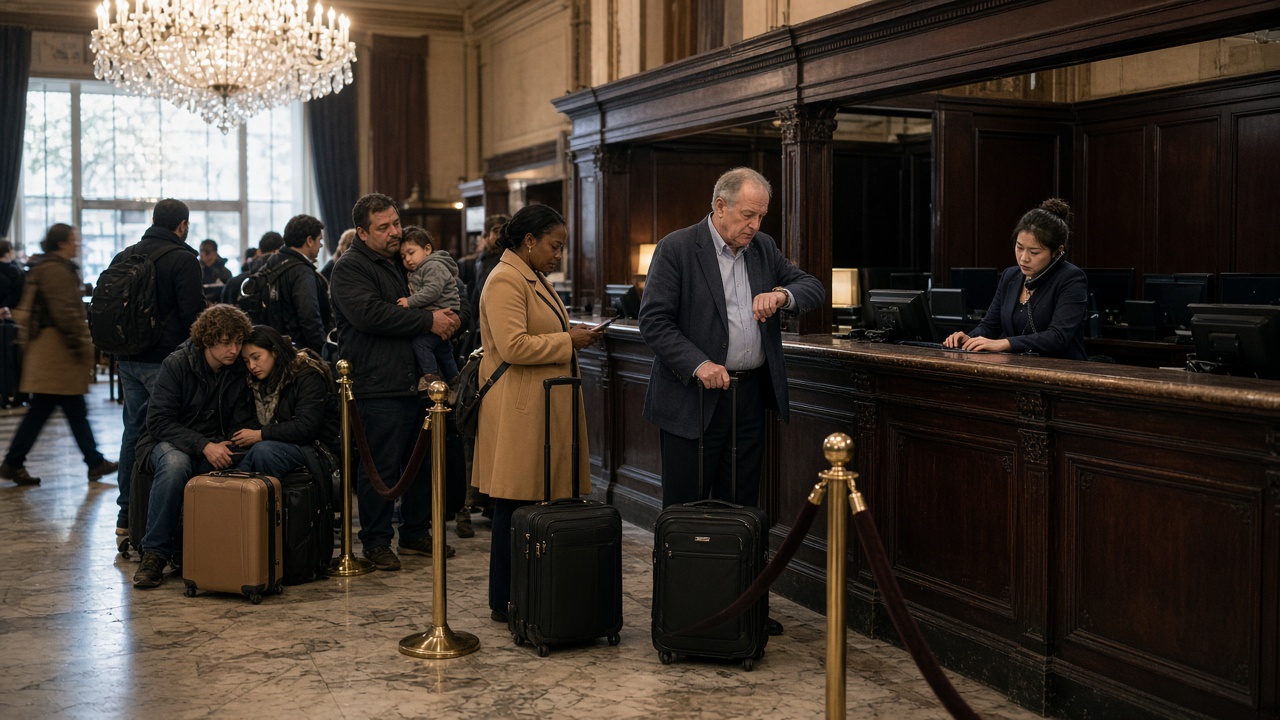
The first round skipped Hyatt entirely, even though Hyatt has the most properties among the 46, according to Skift. The second round hit the Hyatt Regency Chicago and the Hilton Chicago, two of downtown’s best-known convention hotels. These are group houses that live on conventions, and the timing is not friendly: Choose Chicago’s convention calendar shows PACK EXPO running Oct. 18 to 21, the American Heart Association’s Scientific Sessions Nov. 6 to 9 and RSNA from Nov. 29 to Dec. 3. And the market is running hot.
For the week ended Oct. 10, CoStar data reported by Asian Hospitality showed Chicago occupancy up 6.8% to 82.7% and RevPAR up 21.1% to $210.18, the second-largest occupancy gain among the top 25 U.S. markets. That is the union’s argument in one number.
Both companies say they’re keeping the doors open. “Hyatt has offered competitive wages and benefits, and all employees’ wages and benefits remain unchanged as we negotiate a new agreement,” Daniel Dring, Hyatt’s head of labor relations for the Americas, said in a statement to Hotel Dive and WTTW. A Hilton spokesperson told Hotel Dive the company “remains committed to negotiating fair and reasonable agreements” and has contingency plans in place at the Hilton Chicago.
What Is Actually Holding Up a Deal
The public fight is about wages, health care, pensions and workloads. But a source familiar with the hotels’ bargaining position told Skift that talks have stalled on something else: a clause that would automatically extend union representation to a signing company’s other commonly owned or managed hotels in Illinois, Indiana, Wisconsin and Iowa. According to that source, economic terms have not yet been substantively discussed. Skift said it did not hear back from Local 1 on that account. As of Oct. 20, we found no public wage offer from either side and no tentative agreement at any of the 46 hotels.
If that is right, it matters to you even if you have never owned a hotel in Chicago. A clause like that would reach suburban and select-service hotels run by the same management company, in four states. If you own a Midwest hotel managed by one of the companies at the table, ask your operator what it has agreed to, or proposed, before it shows up in your management agreement’s labor provisions.
The Owner Pays the Wage, Not the Brand
The union points to the $22.3 billion in shareholder returns. As Skift noted, those buybacks are funded mostly by brand fee income. The payroll is carried by the owners and operators of the hotels, and their margins are already shrinking. Skift, citing Lodging Analytics Research & Consulting, reported that U.S. hotel EBITDA fell 2.4% in 2024 and 4.3% in 2025. It also cited CBRE data showing labor was just over half of U.S. hotel operating expenses in 2023.
The gap between union and non-union hotels is already large. A HotStats analysis of 2025 data put the average labor cost ratio at 43.0% for unionized U.S. hotels and 33.5% for non-union properties, with GOP margins of 30.3% and 36.5%. Contracts set in Chicago this fall will decide whether that gap widens.
Owners are already reaching for a workaround. In its October U.S. market pulse, HVS said finding staff “in a time of heightened ICE activity is another concern,” and that “contracting out entire departments is also becoming more the norm than the exception.” Outsourcing housekeeping or banquets can move the wage risk off your payroll, but read any new union contract’s subcontracting language first; that is exactly the kind of clause these fights are about.
The labor pool is the industry’s other pressure point. In an AHLA survey of 246 hoteliers conducted in late February, 65% cited labor costs as a top concern and 42% cited workforce shortages, with more than half saying they were understaffed. In a Jan. 30 statement on supplemental H-2B visas, AHLA CEO Rosanna Maietta urged Congress to “grow the legal labor pool.”
How a Chicago Wage Becomes Your Wage
Start with the national baseline. HotelData.com’s H1 2026 labor report, based on data from about 5,000 hotels, put the average full-service room attendant wage at $17.53 an hour, up 3.1% from a year earlier. Wage growth across tracked housekeeping roles ran between 2.9% and 3.3%.
Then look at what union markets settled for this year. As we reported in September, Seattle’s Embassy Suites contract pushes housekeeper starting pay to $31.03 by January 2027, and Philadelphia’s settled contracts include raises to $30 an hour by 2028 for non-tipped workers, higher pension contributions and a 15-room daily cleaning cap, the Philadelphia Inquirer reported. Seattle’s number is 77% above that national average.
Here is what that spread does per room. HotelData’s report puts full-service room attendant time at about 25.6 minutes per occupied room. Our illustrative math, using those figures:
- At $17.53 an hour, room attendant wages cost about $7.49 per occupied room.
- At $31.03 an hour, the same work costs about $13.25, or $5.76 more, before benefits and payroll taxes.
- For a 300-room hotel at 70% occupancy (about 76,650 occupied rooms a year), that is roughly $442,000 a year from one job class.
You do not need to be union to feel it. Once a big market publishes a number, non-union hotels hiring from the same labor pool hear it in every interview, and Chicago, with 46 hotels at the table, is a far bigger comparable than Seattle or Philadelphia.

Calculator
What a raise costs your hotel
Turn an hourly raise into dollars per room. Use the presets from this story or enter your own hotel.
This calculator needs JavaScript. The worked example in this story: moving room attendants from $17.53 to $31.03 an hour, at about 25.6 minutes per occupied room, costs a 300-room hotel at 70% occupancy roughly $442,000 a year in wages alone, before benefits and payroll taxes.
Payroll taxes and wage-linked benefits, as a % of wages.
Fields open with example inputs from this story and the sources named on each preset. Replace them with your own hotel’s numbers.
How this is calculated
- Occupied room nights a year = rooms × 365 × occupancy.
- Paid hours a year = occupied room nights × minutes per occupied room ÷ 60, or employees × 2,080 hours (40 hours × 52 weeks, one full-time year).
- Raise per hour = the dollar amount, or current wage × percent, or target wage − current wage (never below zero).
- Added annual cost = paid hours × raise per hour × (1 + benefit load).
- Per key = added cost ÷ rooms. Per occupied room night = added cost ÷ occupied room nights. RevPAR needed = added cost ÷ (rooms × 365).
Preset sources: HotelData.com H1 2026 labor report ($17.53, 25.6 minutes); Axios ($16 doorman); Chicago Sun-Times ($26.50 dishwasher); Philadelphia Inquirer ($30 by 2028); our Sept. 25 story ($31.03 Seattle); BLS ECEC table 4 (accommodation and food services: $3.85 benefits per $16.18 wages) and table 5 (union workers: $25.54 per $37.52); CoStar via Asian Hospitality (82.7%).
An estimate, not financial, legal or accounting advice. It assumes the raise applies to every paid hour you enter and leaves out tips, overtime, scheduling changes and productivity. Benefit loads are averages; costs fixed per employee, such as health premiums, may not rise with a raise.
What This Means for Your Hotel
- Re-run your 2027 labor budget at two wage paths. Use your current 3% raise assumption and a second case that moves housekeeping toward your market’s highest public settlement. Know the gap in dollars per occupied room.
- Ask your management company where it is bargaining. If it runs hotels in Chicago or any union market, ask what it has proposed, and whether any multi-property recognition clause could reach your hotel.
- Read your group contracts. If you sell to convention groups, check your force majeure and labor-dispute language before the next citywide event, not during it.
- Track hours per occupied room monthly. It is the one labor metric you control. HotelData found full-service hotels cut it 3.1% in the first half of 2026, but gains slowed in the second quarter.
- Price retention before you have to. If you are non-union in a union market, compare the cost of a raise now with what turnover already costs you to recruit and train.
- Price outsourcing honestly. If you are weighing a staffing firm for housekeeping or banquets, compare the all-in contract rate with your loaded wage cost, and check any union contract’s subcontracting terms first.
The Bottom Line
Chicago is no longer a strike threat. It is a strike, at eight hotels so far, in a market posting 21% RevPAR gains. Whatever wage number ends it will become the next comparable for every hotel competing for housekeepers in a major market. Budget for it now, while it is still a scenario and not a contract.
This article reports on an ongoing labor dispute. Positions and figures attributed to the union, the hotel companies and unnamed sources are their claims as reported. The per-room cost example is Hotelier Times illustrative math, not a forecast.
Sources and further reading
- Workers at 2 Chicago hotels go on strike, demand better pay and benefits — CBS Chicago, 2026-10-18
- Chicago Hotel Workers Expand Strike as They Negotiate Wages, Working Conditions — WTTW News, 2026-10-19
- Hundreds of union hotel workers on strike in Chicago — Hotel Dive, updated 2026-10-19
- Chicago Hotel Strike Hits Marriott and Hilton Hotels During Marathon Weekend — Skift, 2026-10-09
- Chicago hotel workers union says strike could expand — Axios Chicago, 2026-10-12
- CoStar: Metrics rise for week ended Oct. 10 — Asian Hospitality, 2026-10-20
- Chicago hotel supply — Choose Chicago
- Chicago convention calendar — Choose Chicago
- Hilton Garden Inn workers vote to authorize strike — Philadelphia Inquirer, 2026-10-14
- HVS U.S. Market Pulse, October 2026 — HVS
- Rising cost, staffing challenges persist for hotels — AHLA
- AHLA statement on release of supplemental H-2B visas — AHLA, 2026-01-30
- H1 2026 Hotel Labor Costs & Productivity Report — HotelData.com, 2026-09-17
- US Hotels Face Profit Pressure as Labor Costs Outpace Recovery — HotStats
- 46 Hotels, One Vote: What Chicago’s Strike Authorization Really Signals — The Hotelier Times, 2026-09-25

Comments
No comments yet. Start the conversation.