+46 Hotels, One Vote: What Chicago’s Strike Authorization Really Signals
Update, Oct. 18, 2026: The strike has spread to the Hilton Chicago and the Hyatt Regency Chicago. Read the latest: what it means for your labor budget →
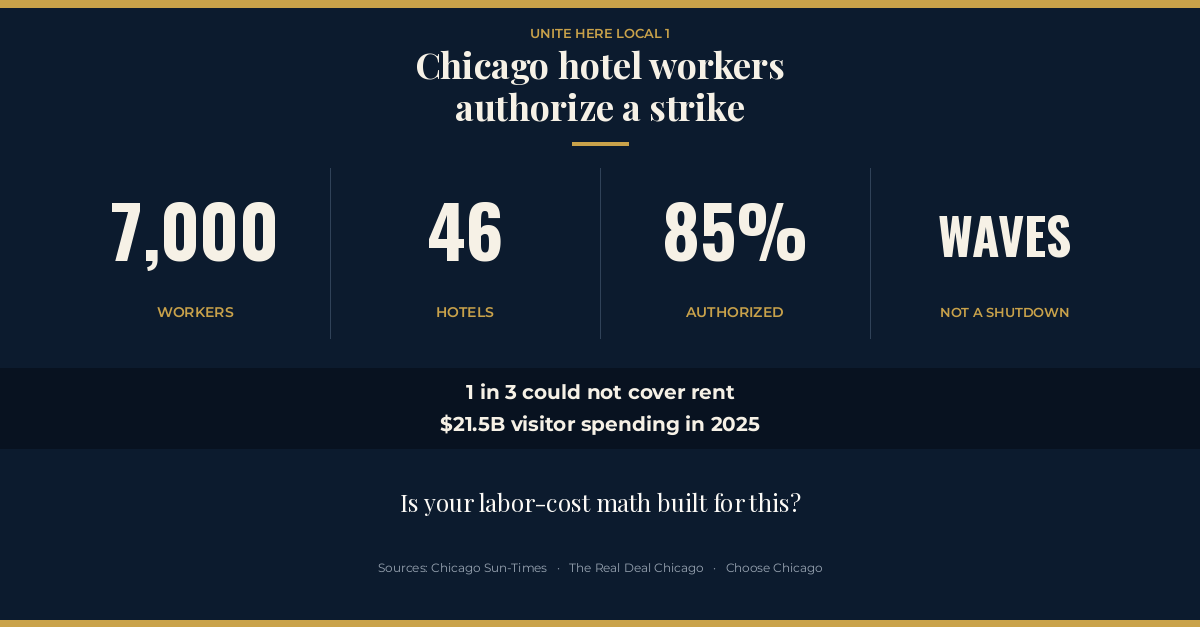
Eighty-five percent of 7,000 Chicago hotel workers just voted to authorize a strike during the city’s busiest convention stretch of the year. The wage numbers behind that vote should worry every operator who thinks this is someone else’s labor market.
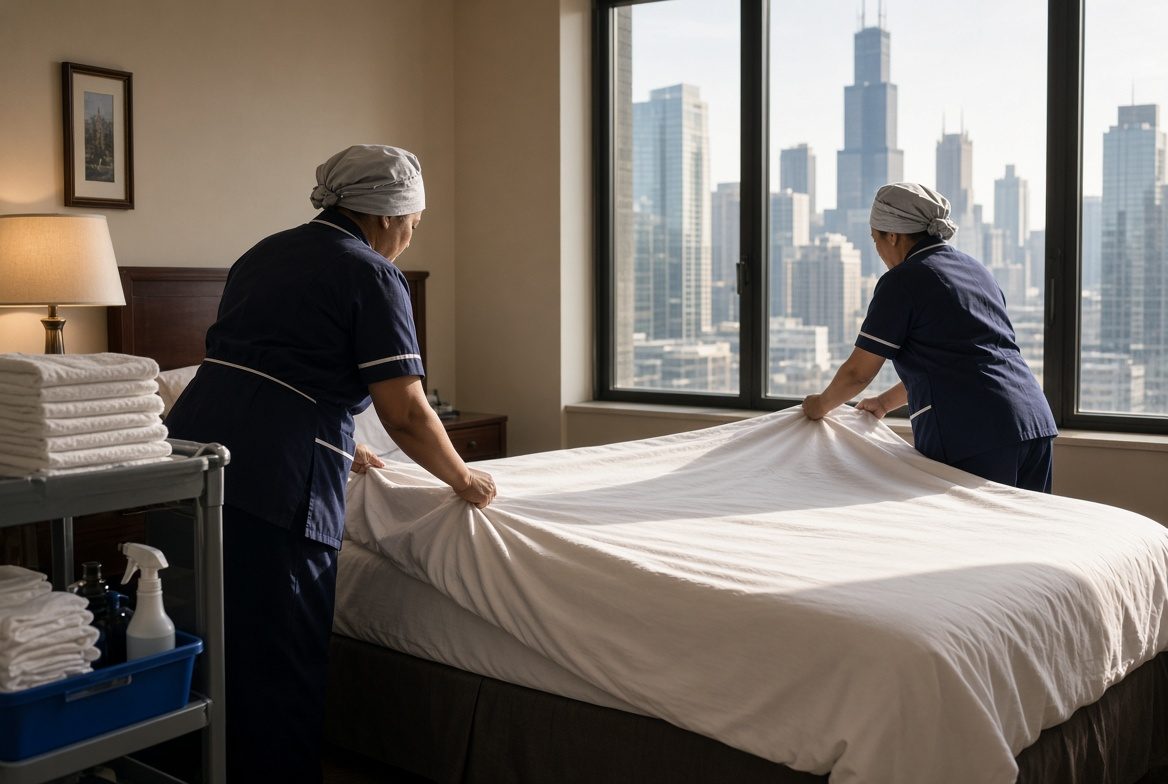
The industry has a talent for filing labor news under someone else’s letterhead. Resist it. On September 21, more than 7,000 hotel workers across 46 downtown Chicago hotels — including properties operated by Hilton, Hyatt, and Marriott — voted to authorize a strike. The margin was not close: 85 percent in favor. UNITE HERE Local 1 represents room attendants, cooks, dishwashers, front-desk agents, servers, and food-service staff whose contracts expired August 31 after negotiations that began in June failed to produce a new agreement (Chicago Sun-Times, 2026; Hotel Dive, 2026).
The thesis is the same one Seattle published two weeks earlier and Philadelphia published in June: a booming hospitality market and a floor staff that says the boom has not reached them is not a local dispute. It is a price-discovery event. A publicly settled wage in one convention city becomes the number every hospitality worker in that labor market — unionized or not — now knows to expect (Snyder, 2026; Hotel Dive, 2026).
The numbers behind the 85 percent
Local 1 president Karen Kent framed the timing as the point: “Tourism in Chicago is booming, all while inflation is increasing, and it’s affecting our hotel workers across the industry.” Choose Chicago reported roughly 3.56 million hotel rooms booked across the city over the summer months alone. The union is not arguing the industry is struggling. It is arguing the industry is thriving and the people running the floor are not seeing it (Chicago Sun-Times, 2026; RUS Tourism News, 2026).
A union survey of its membership found nearly a third of workers could not cover rent or a mortgage payment over the past year, roughly 30 percent lacked enough left over for utility bills, two-thirds had hours cut in the slow period, and about one in four had taken out a payday or short-term loan — all while working full-time in one of the country’s largest hotel markets (Chicago Tribune, 2026; CBS Chicago, 2026).
The individual accounts carry more weight than the percentages. Cassandra Pope, a room attendant at the Palmer House Hilton, put the scheduling problem plainly: “I’ve had enough. They’re putting us on the schedule six consecutive days without even asking us.” Maurice Deloach, a housekeeper at the Drake, framed healthcare as non-negotiable: “Health care — it isn’t a perk. It’s something we deserve.” Valencia Smith, a housekeeper at the Marriott Marquis, described the physical toll directly. Christianell Mitchell pointed to last-minute shift extensions that make a household budget a rumor. Ilene Brown, a housekeeper at the Hilton Chicago, reduced the inflation argument to four words: “Everything is going up” (CBS Chicago, 2026; Chicago Tribune, 2026).
The timing is not an accident
Chicago entered strike-authorization territory during one of its busiest convention stretches of the year. IMTS 2026 — one of North America’s largest manufacturing-technology exhibitions — ran September 14 through 19 at McCormick Place, pulling thousands of business travelers into downtown hotels during the exact window contract negotiations were collapsing. More major conventions follow through the fall. The union has specifically flagged the Bank of America Chicago Marathon as a potential flashpoint if a strike is called (CBS Chicago, 2026; RUS Tourism News, 2026).
That is not incidental leverage. It is the same strategic logic UNITE HERE has used all year. Seattle’s Embassy Suites strike ran the full length of the FIFA World Cup’s local matches this summer before ending after 85 days with a contract that will push housekeeper starting pay to $31.03 an hour by January 2027. Philadelphia’s UNITE HERE Local 274 set a strike deadline at six hotels during the same World Cup stretch, landing settlements with $30-an-hour targets by 2028 and capped housekeeping workloads. Chicago is the same organizing model, run again, at nearly ten times Seattle’s scale — 7,000 workers across 46 properties instead of roughly 115 across one (Hotel Dive, 2026; Snyder, 2026).
Comments
No comments yet. Start the conversation.