+1.11 Points, $2.3 Billion: Why U.S. Hotel Owners Are Keeping Less of Every Guest Dollar
Here is the number that should keep you up tonight: 1.11. That is how many percentage points of every guest dollar U.S. hotels stopped keeping last year. It sounds like a rounding error. It is not. It works out to $2.3 billion that left the industry’s hands, and roughly $29.2 billion of hotel asset value that went with it.
The arithmetic belongs to Kalibri, the hotel data and analytics firm led by its co-founder and chief executive, Cindy Estis Green, who has spent years doing something most of the industry would rather not do, which is count what it really costs to put a guest in a bed. At the Skift Commerce Summit, she and Tyler Morse, chairman and chief executive of MCR, laid out the squeeze from two sides. She brought the ledger. He brought the view from the job site. Together they explained, more clearly than anyone, a squeeze every owner already feels in the monthly P&L.
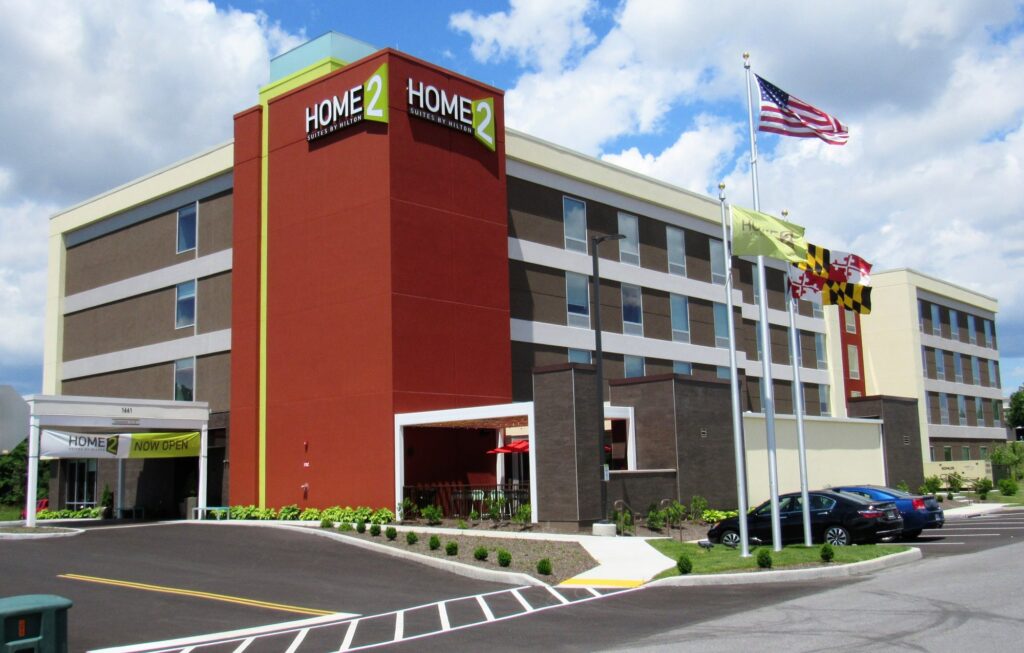
Top photo: A Home2 Suites by Hilton in Hagerstown, Maryland. Tyler Morse put the cost of building a new stick-built Home2 today at about $250,000 a key. Photo: Farragutful, CC BY-SA 4.0, via Wikimedia Commons.
The leak nobody books as a line item
Start with the guest. In 2025, guests paid U.S. hotels about $211.4 billion, slightly more than the $211.1 billion of the year before, by Kalibri‘s count. So far, so good. But by the time the commissions, wholesale margins, loyalty charges, channel costs and sales and marketing expense had been taken out, what hotels kept fell to about $167.5 billion, down from about $169.5 billion. Guests spent more. Hotels kept less.
Kalibri calls the share that survives that trip “revenue capture.” It was 80.33% in 2024. It was 79.22% in 2025. Customer acquisition costs, in Kalibri’s analysis, run 20% to 30% of guest-paid revenue. That is not a marketing budget. That is a partner with a claim on a fifth or more of your top line, and most owners never see it in one place.
What makes Estis Green’s work so valuable is that she refuses to let the problem stay abstract. She ties the lost capture directly to what a hotel is worth, because a buyer pays for the cash flow you keep, not the revenue you book. Lose a point of capture across an industry and you do not just lose a year of profit. You lose it every year, capitalized into the price of the building.
Bad math, said plainly
Then comes the other blade of the scissors. Kalibri expects revenue growth of zero to 3% a year while expenses, from interest rates and insurance to property taxes, renovation reserves, utilities and labor, keep climbing 5% to 10%. Estis Green put it more simply than any spreadsheet could.
“Expenses have grown five to 10%, while revenue is growing zero to three percent,” she told Hotel Business. “That’s just not good math.”
Here is the part that makes her an optimist rather than a prophet of doom. She has also shown owners where the money is hiding. In a profitability program Kalibri presented through AAHOA, her team went looking for margin.
“We came up with nine points of GOP improvement just from low-hanging fruit,” Estis Green said. “Maybe a hotel only captures three points instead of nine, but for many owners that can make a tremendous difference while revenue growth remains modest.”
The view from the owner’s chair
If Estis Green is the industry’s accountant of last resort, Tyler Morse is one of its most imaginative builders. He founded MCR in 2006, and it has grown into the third-largest hotel owner-operator in the United States, with 150 hotels and more than 25,000 rooms across 37 states, run under 29 brands, from nine Marriott and eight Hilton brands to independents. MCR is the developer behind the TWA Hotel at JFK Airport and London’s BT Tower project. When a man with that record tells you how a hotel pencils, you listen.
He did not come to complain. “Business is great right now,” Morse said, and the demand numbers back him up. Marriott reported that RevPAR in the U.S. and Canada rose 7.4% in the third quarter of 2026.
But the cost of building has moved faster than the rate. Morse told the summit audience that construction costs have climbed about 50% in five years, and that a stick-built Home2 Suites now runs about $250,000 a key, a cost he said takes something like a $200 average daily rate to justify. For a lot of owners in a lot of markets, that rate is not there.
Why the brands are converting instead of building
The industry’s answer is written in Marriott’s own numbers. In its third-quarter 2026 results, the company said conversions made up more than a third of its signings and more than 40% of its openings in the first nine months of the year. On the earnings call, chief executive Tony Capuano tied the conversion push to construction starts that have not returned to pre-pandemic levels, and said Marriott has built a deliberate stack of conversion-friendly brands and development teams focused on single-asset and portfolio deals.
Keep reading
Keep reading with full access: a 24-hour Day Pass is $1.39, or $1.99 your first month, then $3.99/mo — or $19.95/year (Save $27.93 a year vs. $3.99/mo, about 58%).
Already a member? Log in

Comments
No comments yet. Start the conversation.