The Refi Clock: 596 Hotel Loans, $18.7 Billion, and a Fed That Just Raised Rates
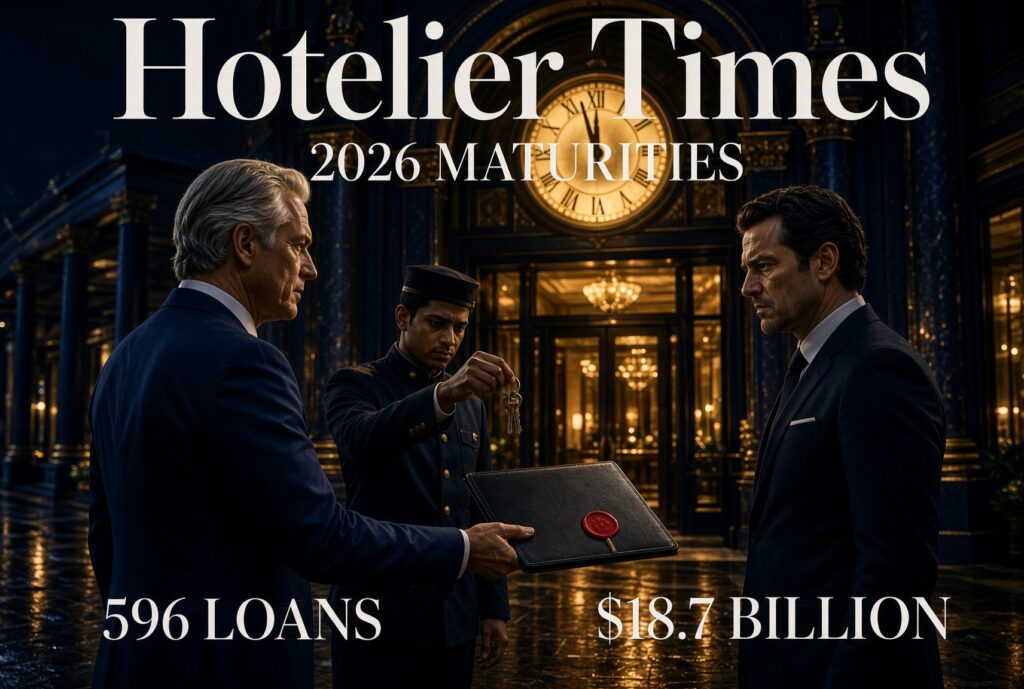
Hotel loan distress is rising again just as thousands of owners face their maturity date, and the number your lender cares about most is not your hotel’s value.
For most of this year, the hotel debt story sounded like good news. Then the Federal Reserve did something few owners had planned for.
On Sept. 16, 2026, the Fed’s rate committee voted 12 to 0 to raise the federal funds target range by a quarter point, to 3.75% to 4%. It was the first increase since 2023, according to Advisor Perspectives’ summary of the decision, and it came in a year when a large wave of hotel loans is coming due.
According to an analysis by attorneys Peyton McClinton and Colin C. Stouffer of the law firm FBT Gibbons, citing Trepp data, 596 hotel-backed CMBS loans with a combined balance of $18.7 billion mature in 2026. Asian Hospitality, reporting on the same figures on Sept. 28, said nearly 70% of that debt carries floating-rate terms.
If your hotel loan floats, the Fed’s move has already reached your interest bill. If it is fixed and maturing, the question is what your next loan will cost and how much a lender will give you.
The Delinquency Line Is Moving the Wrong Way Again
Trepp tracks the share of CMBS loans that are 30 or more days late. For hotels, 2026 has been a round trip. The lodging delinquency rate stood at 5.56% in January, jumped to 7.31% in March, then fell to 5.22% in June, its best reading of the year, according to Trepp’s monthly figures as compiled by Multi-Housing News.
Since then it has climbed two months in a row: 5.35% in July and 5.84% in August. That is a rise of 62 basis points in two months. Trepp attributed August’s increase to newly delinquent balances from a New Orleans hotel and a national hotel portfolio that outweighed a smaller group of cures.
The broader warning sign is special servicing, where loans go when a borrower is in trouble or about to be. Trepp’s overall special servicing rate hit 11.42% in August, its highest level since February 2013, Connect CRE reported on Sept. 17. The lodging rate rose 11 basis points to 8.74%, and the Hyatt Regency New Orleans was among the large loans transferred to a special servicer that month.
What Maturity Trouble Looks Like Up Close
A case from last month shows how a maturity date turns into a crisis. On Sept. 15, Commercial Observer reported that the $100 million CMBS loan on the 351-room Hyatt Regency Jersey City was sent to special servicing for imminent maturity default. Citing Morningstar Credit Analytics, it reported that the owners, Taconic Capital Advisors and HEI Hotels & Resorts, said they would not be able to pay off the loan ahead of its October 2026 maturity.
The numbers tell the story. Taconic and HEI bought the hotel in December 2022 for $117 million, about $333,000 a key. The loan works out to about $285,000 a key. The report said the hotel has met its underwritten cash flow in only one year since the loan was made in 2016, and posted negative cash flow in 2024.
You do not need to own a 351-room urban Hyatt to learn from this. Underwriting from 2016 met operating results from 2026, and the maturity date did not move.
The Rate Gap Is Real, but It Is Not the Whole Problem
FBT Gibbons’ attorneys put the rate gap plainly: hotel loans originated in 2016 or 2021 may carry rates of 4% to 6%, while a new 2026 loan may come at 6% to 7%. Bridge, a commercial lending marketplace, put stabilized hotel debt at about 7.5% to 8.5% all-in fixed in its Q2 2026 report, and transitional bridge loans at SOFR plus 3.5 to 5 percentage points.
Here is what the Fed’s quarter point means in dollars. On an $8 million floating-rate loan, 0.25 percentage point is about $20,000 a year in extra interest, or roughly $1,670 a month, before any change in the lender’s spread.
But the lenders we read are clear that rate is not the gate. Debt yield is.
Keep reading
Read the rest of this article with a $0.99 day pass, or subscribe for $1.99 per month.
Already a member? Log in


Comments
No comments yet. Start the conversation.