The 2.1 Percent Budget: Why Next Year’s Revenue Forecast Won’t Pay Next Year’s Bills
Click to listen to the audio version of this article.
Two forecasters who disagree about 2026 landed on the same number for 2027, and it is smaller than the raise hotel workers got this year.
The One Number Everyone Agrees On
Hotel forecasters rarely agree. This year they could not even agree on the year we are living in. In August, CoStar and Tourism Economics raised their 2026 call to RevPAR growth of 4.4 percent. CBRE’s midyear outlook, even after its own upgrade from 1.2 percent, has 2026 at 2.5 percent.
Then they looked at 2027 and wrote down the same thing: 2.1 percent RevPAR growth.
CoStar and Tourism Economics break it down as average daily rate up 1.6 percent and demand up 1.1 percent, with occupancy at 63.4 percent. CBRE has ADR up 1.7 percent and occupancy at 63.0 percent. CoStar’s own summary calls 2027 “sustained recovery” rather than acceleration. Jan Freitag of CoStar called the coming year “smooth sailing” from a revenue perspective.
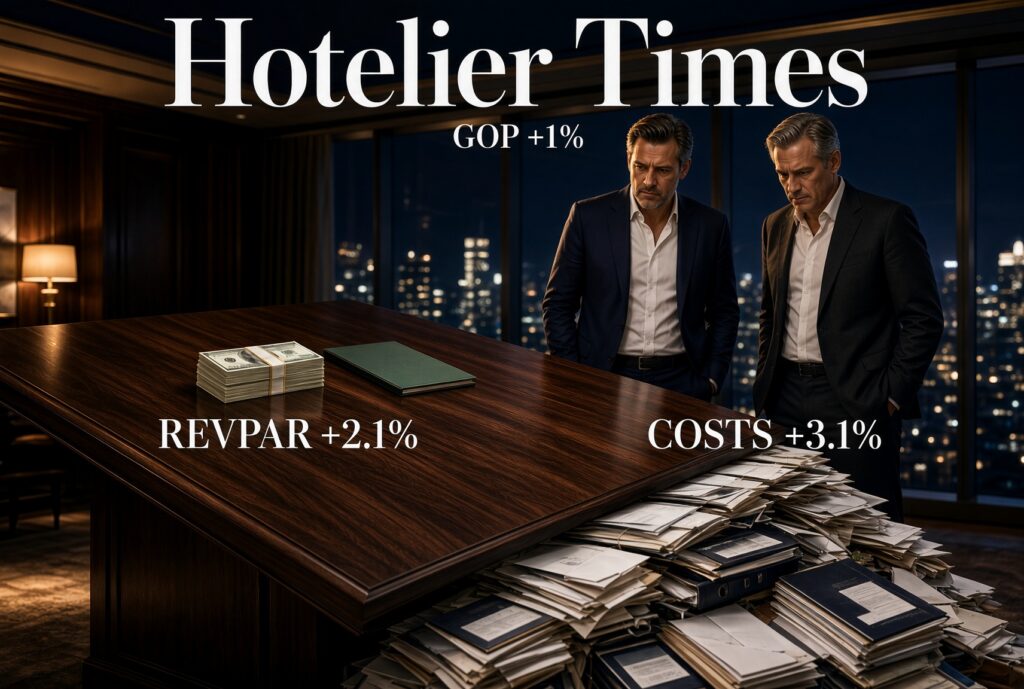
Smooth is the right word for the top line. The trouble is in the line next to it: gross operating profit per available room is forecast to grow just 1 percent in 2027, according to CoStar and Tourism Economics as reported by HotelData.com. Revenue up 2.1, profit up 1. Something in the middle of the P&L is eating the difference, and it is the same thing that ate it in 2025.
Rate Is Lagging Inflation, and That Is the Whole Problem
The forecast that pairs with that 1.6 percent ADR assumes inflation of 2.3 percent in 2027. At STR’s Hotel Data Conference in August, senior forecasting analyst Jake Bruno told the room that ADR is “expected to remain below the inflation rate.”
Read that again as an owner. Your room rate, the one number you set yourself, is projected to lose ground to the price of everything you buy.
We have already seen this movie. In 2025, total operating revenue for U.S. hotels rose 2.6 percent and rooms revenue just 1.1 percent, according to Tommy Crozier’s analysis in Lodging magazine, while total hotel expenses rose 3.1 percent. The GOP margin slipped from 35.1 percent to 34.8 percent, and the EBITDA margin from 23.3 percent to 22.8 percent. EBITDA dollars rose 0.3 percent, which is a rounding error dressed up as growth. Crozier’s verdict: “Revenue growth is stalling, while expenses accelerate at an unsustainable pace.”
CoStar’s numbers through October 2025 told the same story from another angle: labor rose from 34 percent of revenue in 2024 to 35 percent in 2025.
Where the Money Goes in 2027
Labor: cheaper per hour worked, pricier per room sold
Labor is the largest line on any hotel P&L, and it is still climbing. In the first quarter of 2026, wages at about 5,000 hotels tracked by Actabl rose 2.91 percent year over year, according to HotelData.com. Select-service wages rose 2.81 percent.
Here is the part worth copying: those same hotels cut hours per occupied room by 2.3 percent, and select-service hotels cut them 4.2 percent. Room attendants went from 24.99 to 23.91 minutes per occupied room. The result: labor cost per occupied room at select-service hotels rose only 2.5 percent, to $30.36, instead of tracking wages. Hotels paid people more and scheduled them better. That is the only labor strategy that survives a 1.6 percent rate year.
Insurance: the property bill is falling, the liability bill is not
This is the one line where many owners can find real money in 2027. Insurance premiums fell 5.3 percent in 2025, per Crozier. In September, Insurance Journal reported on Amwins’ hospitality market study, which found hotels in favorable locations commonly getting property premium reductions of 15 to 25 percent.
But Amwins’ Dana Fansler called it “a tale of two markets,” with casualty still hard because of social inflation, nuclear verdicts and more litigation. Lockton’s February 2026 update said umbrella and excess capacity has tightened, with $5 million lead layers now common and some insurers offering only $2 million. Amwins also warns that two quotes with similar premiums can carry very different coverage, with assault and battery, human trafficking and liquor liability often sub-limited or excluded.
Translation: if your renewal comes back flat, you may be paying the same money for less coverage.
Fees and taxes ride along with revenue, or faster
Management fees rose 3.8 percent and property taxes 2.4 percent in 2025, per Crozier. If you fly a flag, your royalty, marketing and loyalty charges are percentages of revenue that grow with every dollar you add, and some brands add more lines than others. Our free 164-brand franchise fee spreadsheet shows exactly what your brand charges.
Keep reading
Read the rest of this article with a $0.99 day pass, or subscribe for $1.99 per month.
Already a member? Log in


Comments
No comments yet. Start the conversation.