The 12 Percent Flag: What Owners Really Pay a Brand in 2026, and Why the Royalty Is Only Half the Bill
Click to listen to the audio version of this article.
The franchise agreement says 8% or 9%. The all-in number most owners end up writing checks for is closer to 10% to 13% of rooms revenue, and it has been growing faster than the revenue it is charged on.
Ask a select-service owner what the brand costs and you will usually hear two numbers: the royalty and the marketing fee. At a Holiday Inn Express that is 6% plus 3%. At a Hyatt Place it is 5% plus 3.5%. At a Wingate by Wyndham it is 5.5% plus 3%.
Those numbers are real. We pulled them from the brands' own Franchise Disclosure Documents for The Hotelier Times franchise fee comparison, which now covers 164 brands. But they are not the bill.
"Around 12%. That's the percentage of room revenue a hotel franchisee typically will pay a franchisor," Hotels magazine wrote in an Aug. 17, 2026 report on whether the franchise agreement is still equitable. That is three to four points more than the headline rate on most select-service contracts. On a mid-size hotel, those three or four points are a six-figure number every year.
The Contract Rate: What the FDDs Say
Here is the royalty plus marketing (or "services," "system assessment" or "commercial services") fee for eleven brands an owner of a 100-room select-service or extended-stay hotel is likely to be weighing. All figures come from the brands' FDDs: IHG brands from its 2024 FDD on file in Minnesota (IHG stopped registering FDDs in Minnesota in 2025), Wyndham brands from the 2025 FDD, Hyatt brands from the 2026 FDD.
Holiday Inn Express: 6% royalty + 3% services = 9%
WaterWalk Extended Stay by Wyndham: 6% + 3% = 9%
Hyatt Place: 5% + 3.5% = 8.5%
Wingate by Wyndham: 5.5% + 3% = 8.5%
Baymont by Wyndham: 5% + 3.5% = 8.5%
Travelodge by Wyndham: 5% + 3.5% = 8.5%, plus a daily charge of 5 to 10 cents per room
AmericInn by Wyndham: 5% + 3.25% = 8.25%
avid hotels: 5% + 3% = 8%
Candlewood Suites: 5.5% + 2.5% = 8% (of gross suites revenue)
Hyatt Studios: 5% + 3% = 8%
Trademark Collection by Wyndham (soft brand): 5.5% membership fee + 2% marketing = 7.5%
Initial fees look large on paper and barely matter over a full term. For a 100-room hotel, the FDDs put the initial fee at $75,000 for Holiday Inn Express ($500 a room, $75,000 minimum) and Hyatt Place ($75,000 up to 150 rooms), $50,000 for avid, Candlewood Suites and Hyatt Studios, $38,500 for Wingate ($36,000 plus a $2,500 application fee) and $28,500 for Baymont ($26,000 plus $2,500). The recurring fees on that same hotel run several times the initial fee every single year.
Where the Other Three Points Come From
HVS publishes an annual U.S. Franchise Fee Guide that models the total cost of a franchise over a term, not just the two headline lines. According to the 2025 edition as reported by Hotels magazine, economy brands averaged the lowest total franchise cost, at 9.6% of rooms revenue, while high-end brands averaged the highest, at 12.9%. By product type, median costs ran from 10.9% for extended-stay hotels to 12.5% for full-service hotels.
The gap between the contract rate and that all-in figure is mostly the charges that sit outside the royalty: loyalty program assessments, reservation and distribution fees, and the other system charges listed further back in the FDD.
CBRE Hotels Research put numbers on how those pieces are moving. Robert Mandelbaum and Andrew Hartley studied 4,200 U.S. hotels (average 218 rooms, 70.2% occupancy, $214.89 ADR in 2024) and found that from 2023 to 2024, "total franchise-related fees increase by 3.5%" while rooms revenue gained only 2.7%. The fastest-growing pieces were not the royalty. Guest loyalty program costs rose 3.9% and reservation and marketing assessments rose 3.8%. "The royalty fee, which indirectly generates demand, increased by just 2.7% during the year," the authors wrote.
Two more findings from the same CBRE study matter for owners.
Loyalty is a bigger slice at the top. Guest loyalty payments were more than 33% of total franchise-related payments at luxury and upper-upscale hotels, and less than 13% at economy hotels.
The royalty can be the minority of the bill. At third-party-managed hotels the royalty averaged 49.8% of total franchise-related fees. At brand-managed hotels it was just 15%.
Loyalty alone is now a real line on the P&L. In a separate study of 4,187 U.S. hotels, CBRE found loyalty program fees came to 2.2% of rooms revenue in 2024, highest at upper-upscale hotels and lowest at midscale and economy hotels. Owners also got more out of those programs: loyalty members accounted for 52.8% of occupancy at the five big chains CBRE studied.
What Three Points Cost a 100-Room Hotel
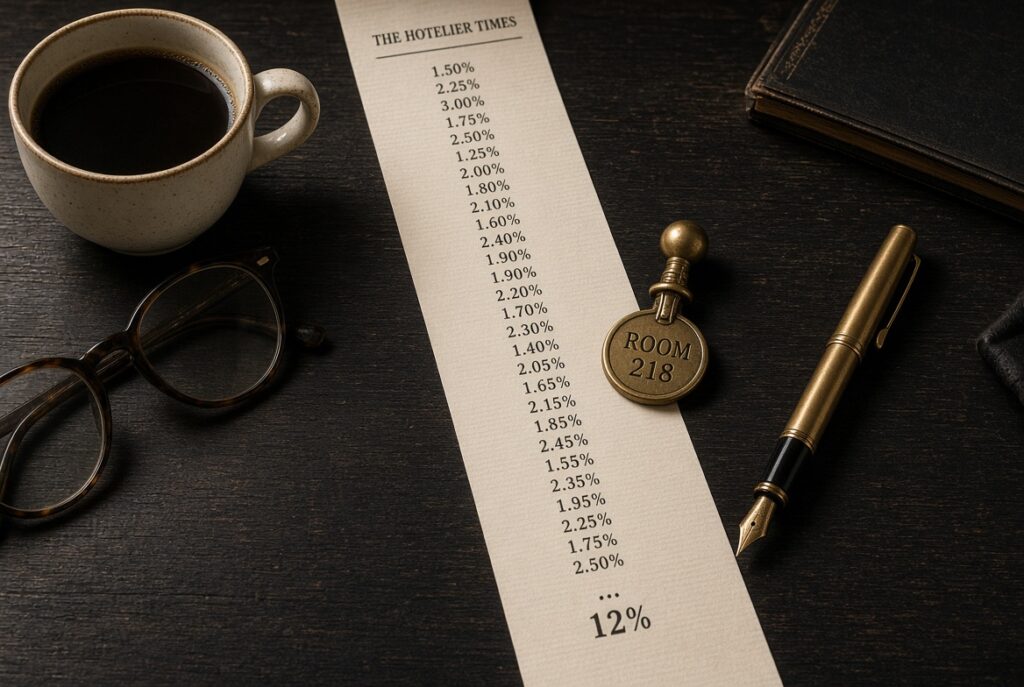
Here is an illustrative example, not a real property. A 100-room hotel running 70% occupancy at a $130 ADR books about $3.32 million in rooms revenue a year (100 rooms x 365 nights x 70% x $130 = $3,321,500).
At a 9% contract rate, royalty and marketing come to about $298,935 a year.
At HVS's 9.6% economy average, total franchise cost is about $318,864.
At the "around 12%" figure Hotels magazine cites, it is about $398,580.
The spread between the 9% the owner remembers signing and 12% is about $99,645 a year. Even a 1.5-point difference between two brands (7.5% vs. 9%) is about $49,823 a year, or roughly $498,000 over 10 years before any revenue growth.
And revenue growth makes the fee bill grow too, because every fee is a percentage. CoStar and Tourism Economics' Q3 2026 forecast expects select-service hotels "to end 2026 at roughly +3.6% RevPAR, with ADR growth around +2.5%." Every one of those new dollars carries the brand's percentage with it.
Why the Number Is Moving the Wrong Way for Some Segments
The pressure is not even across chain scales. CBRE found franchise fee growth was greatest at luxury (6.4%) and upper-upscale (5.0%) hotels from 2023 to 2024, while franchise payments at the midscale hotels in its sample declined 6.6%. A lower fee bill that comes from lower revenue is not a win.
Owners have noticed. Hotels magazine's August report quoted Skift editor-in-chief Sarah Kopit: "The deepest cut was watching the franchise relationship reveal itself as structurally lopsided by design." And HVS found that soft brands such as Ascend Hotel Collection and Curio Collection generally charge 0.4 to 2.0 points less than the hard brands in the same family, which is why our table shows Trademark Collection at 7.5% against 8% to 9% for most Wyndham hard brands.
Read the Contract, Then Read the Back of It
Five things any owner signing, renewing or buying a flagged hotel should do:
- Add up every recurring line, not two. Royalty, marketing, loyalty, reservations, technology and any per-room daily charge. Express each as a percentage of rooms revenue for your own hotel.
- Run the 10-year number. Multiply your rooms revenue by the all-in percentage and by the term. Compare it with the extra revenue the brand projects it will deliver.
- Compare soft and hard brands in the same family. HVS's 0.4 to 2.0 point spread is real money on a $3 million revenue hotel.
- Check the FDD year. Fees change. Our table shows the FDD year for every brand, and IHG's most recent Minnesota filing is from 2024.
- If you are buying, price the flag into the deal. A buyer pays for the next owner's fee load, PIP and all, in the cap rate.
Our franchise fee comparison lists 164 brands side by side, with royalty, marketing and initial fees and the FDD year: hoteliertimes.com/hotel-franchise-fees-comparison
The Bottom Line
The royalty is the number on the term sheet. The bill is what loyalty, reservations and system charges add on top, and CBRE's data says those lines are the ones growing fastest. An owner who compares brands on the royalty alone is comparing the smallest number in the deal.
Get the free spreadsheet of all 164 brands' fees, plus our weekly email of hotel deals and numbers, on our franchise fee comparison page.
Sources
- 1. The Hotelier Times franchise fee comparison (brand FDDs on file with the Minnesota Department of Commerce; IHG 2024, Wyndham 2025, Hyatt 2026): https://hoteliertimes.com/hotel-franchise-fees-comparison/
- 2. Hotels magazine, David Eisen, "The hotel franchise agreement helped build an industry. Is it still equitable?" Aug. 17, 2026: https://hotelsmag.com/news/the-hotel-franchise-agreement-helped-build-an-industry-is-it-still-equitable/
- 3. CBRE, Robert Mandelbaum and Andrew Hartley, "The Cost of Franchising: Core and Soft," Aug. 28, 2025: https://www.cbre.com/insights/articles/the-cost-of-franchising-core-and-soft
- 4. CoStar, "U.S. hotel forecast assumptions, Q3 2026": https://www.costar.com/products/str-benchmark/resources/data-insights-blog/us-hotel-forecast-assumptions-q3-2026
- 5. HVS U.S. Franchise Fee Guide 2025 Edition (figures as reported in source 2): https://hvs.com/article/store/paid/217-hvs-us-franchise-fee-guide-2025-edition
- 6. CBRE via Hotel Online, Rachael Rothman, Robert Mandelbaum and Christine Bang, "For Hotel Owners, Loyalty Program Benefits and Costs Continue to Rise," Oct. 6, 2025: https://www.hotel-online.com/news/for-hotel-owners-loyalty-program-benefits-and-costs-continue-to-rise
Comments
No comments yet. Start the conversation.