Fed Holds Rates Steady: What Hotel Owners Should Do Now
For hotel owners, GMs, lenders and brokers. Published 1:08 p.m. CT, Wednesday, Oct. 28, 2026. Updated 2:35 p.m. CT. The Hotelier Times covered Chair Kevin Warsh’s press conference from 1:30 to about 2:04 p.m. CT.
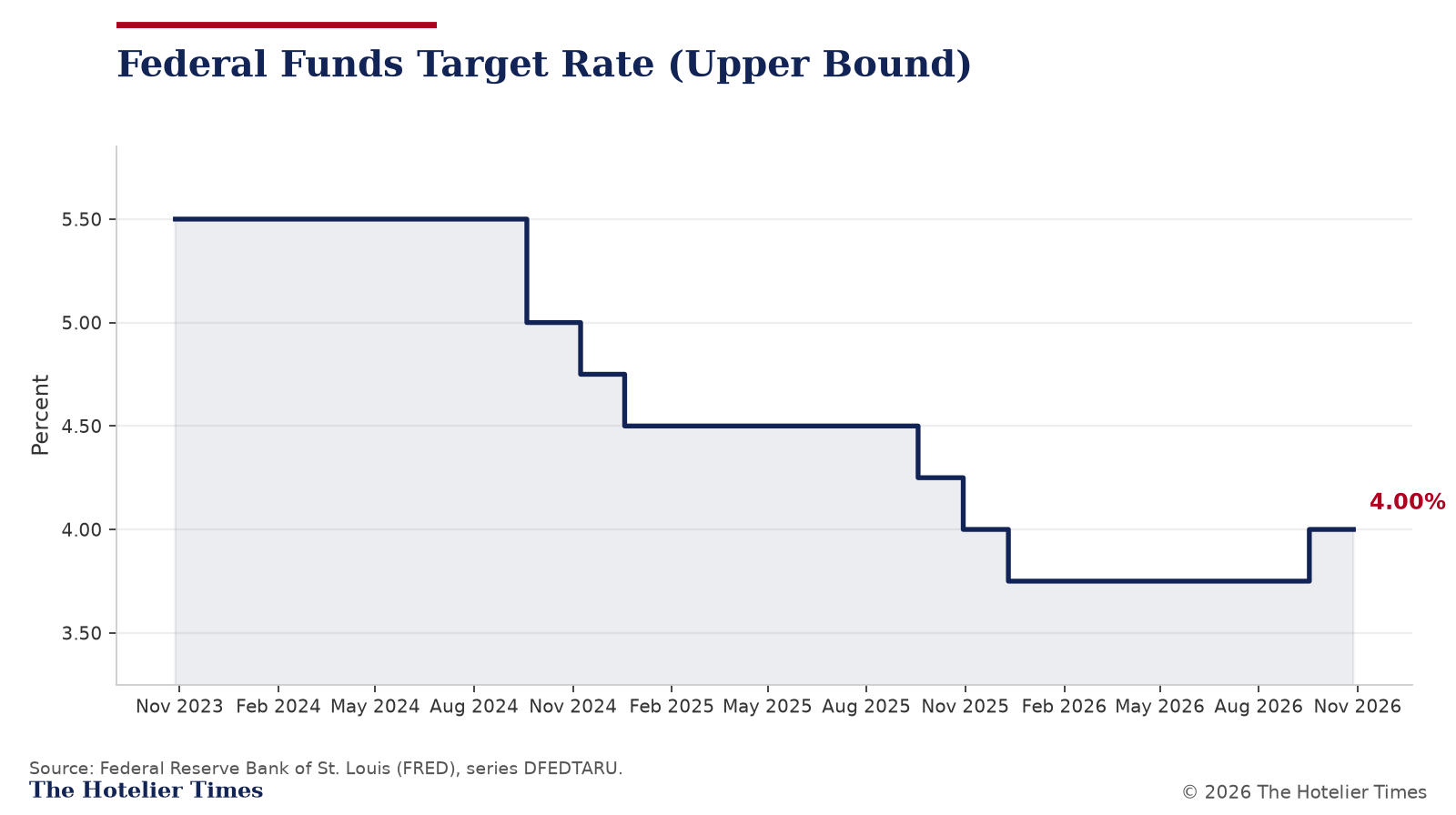
The Federal Reserve left its benchmark rate unchanged on Wednesday, holding the federal funds target range at 3.75% to 4.00% after raising it on Sept. 16. Markets had expected a hold — CME FedWatch priced roughly a 92% chance of no change going in (as of Tuesday evening, Oct. 27). The Federal Open Market Committee approved the statement by a 10–2 vote. (Federal Reserve statement, Oct. 28, 2026)
PRESS CONFERENCE · KEY TAKEAWAYS
- Warsh: no forward guidance on December; won’t prejudge the next meeting — “might learn a lot” first.
- Financial conditions “tightened a bit” since the Sept. hike — “policy is working”; Sept. effects matched expectations.
- Economy strong but not judged “too hot”; goal “isn’t to throw sand in the gears.” Politics “played no role.”
Press conference · key takeaways
Key takeaways below, in order. Press conference ended ~2:04 p.m. CT.
- 1:34 p.m. CT — Opening the press conference, Warsh restated today’s hold of the federal funds target range at 3¾% to 4% and that “inflation remains elevated,” adding that the committee “will deliver price stability.”
- 1:36 p.m. CT — Warsh said first-half GDP was revised up to 2.4% from 1.8%, and third-quarter growth looks stronger, “led by healthy consumer spending,” likely above 3%, with business investment rising at about a double-digit pace.
- 1:38 p.m. CT — On labor, Warsh said the jobless rate is lower than a year ago, payroll growth is above last year’s pace, and the four-week average of unemployment insurance claims is “at the lowest level in generations.” On the employment side of the dual mandate, he said conditions are “quite positive.”
- 1:40 p.m. CT — Warsh said “inflation is too high,” with energy and related prices higher again in recent weeks. He said the Fed’s job is to keep relative price changes from broadening across the economy and to keep inflation expectations anchored.
- 1:42 p.m. CT — Asked why the Fed did not raise rates today, Chair Kevin Warsh said ensuring price stability “is not about some fixed individual date on a calendar.” He said information in the “coming period” will help the committee decide “where we want policy to be.”
- 1:48 p.m. CT — On whether the current funds rate might already be right: Warsh said the committee has no firm conclusion yet — “if we had a firm conclusion about the conduct of monetary policy we’d announce it to much fanfare today.” The “overwhelming” judgment among colleagues, he said, is that the period ahead should bring more clarity on the “appropriate protocol.” He said the post-September “monetary medicine” is “starting to work some.”
- 1:51 p.m. CT — Asked if today’s hold signals a soft inflation target, Warsh said there is “no soft inflation target” and “no implicit inflation target” — “There’s a target of price stability and it’s 2% as measured by PCE.” He said consumers see higher prices at the gas station, so near-term inflation expectations have risen, but longer-horizon measures still show confidence the Fed will deliver.
- 1:53 p.m. CT — On oil and inflation: Warsh said oil prices have moved higher “largely due to geopolitical events,” with crack spreads still elevated, while market interest rates recently “rolled over to the downside.” He declined to speculate on what falling oil would mean for the dual mandate.
- 1:55 p.m. CT — On whether AI investment is less sensitive to rates than housing, Warsh said interest rates “get in the cracks” and affect “almost everything.” Since September, he said investors are more discriminating, credit spreads have widened for some assets, and financial conditions have tightened some “but not significantly.” Capex, he said, is “broadening” beyond a narrow tech story.
- 1:56 p.m. CT — On midterms: “Politics played no role in the decision.” Warsh said he heard no talk of politics or elections in the two-day meeting. The “information-rich” period ahead, he said, has “nothing to do with politics.”
- 1:58 p.m. CT — On December / another hike this year: Warsh said he does not believe in forward guidance “absent exigent circumstances” and does not “believe in prejudging meetings.” He would not share “musings about what happens when this group gets together six weeks from now,” but said the committee “might learn a lot” in the coming period and be “better positioned” on the policy stance. Colleagues may speak after the blackout ends later this week.
- 2:00 p.m. CT — Asked whether September’s rate hike delivered what the Fed expected, Warsh said effects on financial-market conditions “were consistent with my expectations.”
- 2:02 p.m. CT — On whether strong demand (including AI investment) is adding to inflation: Warsh said most colleagues do not judge the economy to be “running too hot,” and that higher productivity has been lifting growth for a couple of years. The goal “isn’t to throw sand in the gears of the economy and throw people out of work.” Financial conditions have “tightened a bit” since September — “that tells me the policy is working.”
- 2:04 p.m. CT — Press conference ended. Chair Kevin Warsh took no further questions.
What the Fed said
In its Oct. 28 statement, the Committee said it “decided to maintain the target range for the federal funds rate at 3-3/4 to 4 percent, in support of the Federal Reserve’s dual mandate.” It also said: “The Committee is continuing its policy of maintaining ample reserves in the banking system.”
On the economy, the statement said: “Economic activity is expanding at a strong pace.” It added: “While uncertainty remains elevated owing, in part, to geopolitical developments, domestic spending has been resilient. Productivity growth is strong, and capital investment is robust. Job gains have kept pace with the workforce, and the unemployment rate has changed little.”
On prices, the Committee said: “Inflation remains elevated.” It continued: “The accumulation of more information will help the Committee determine the policy stance appropriate to ensure a timely return of inflation to the Committee’s 2 percent goal. The Committee will deliver price stability.”
How we got here: the Sept. 16 hike
On Sept. 16, 2026, the FOMC raised the target range by 1/4 percentage point to 3-3/4 to 4 percent, in a unanimous vote. That statement also said “Inflation remains elevated” and that the action would “support a timelier return to the Committee’s 2 percent goal.” (Federal Reserve statement, Sept. 16, 2026)
Wednesday’s hold leaves that 3.75%–4.00% range in place. The upper bound of 4.00% is the series DFEDTARU reading through Oct. 28 on FRED.
The two dissents
Voting against the Oct. 28 action were Lisa D. Cook and Beth M. Hammack, “who preferred to raise the target range for the federal funds rate by 1/4 percentage point at this meeting,” the Fed said. Two dissents favoring a hike — rather than a cut — are why markets often call this a hawkish hold. CNBC Fed Survey respondents had expected at least two dissents from a hold.
What comes next
Chair Kevin Warsh’s press conference ran from 1:30 to about 2:04 p.m. CT; key takeaways are above.
The next FOMC meeting is Dec. 8–9, 2026, and that meeting includes a Summary of Economic Projections, per the Federal Reserve FOMC calendar. Going into today, CME FedWatch priced roughly four-fifths odds of a higher rate after that December meeting. After the decision, CME FedWatch still implied about an 85.7% chance of a December hike, per CNBC’s Treasuries report (updated around the post-decision window). The CNBC Fed Survey found 76% of respondents expect a December hike.
Warsh also said the FOMC will keep eight meetings a year, but in 2027 one meeting will focus “exclusively on broad monetary policy strategy, with neither a vote on the federal funds rate nor a policy statement anticipated,” and that he expects two strategy meetings and six policy-setting meetings in 2028. (Fed opening-statement PDF)
The 10-year and the financing backdrop
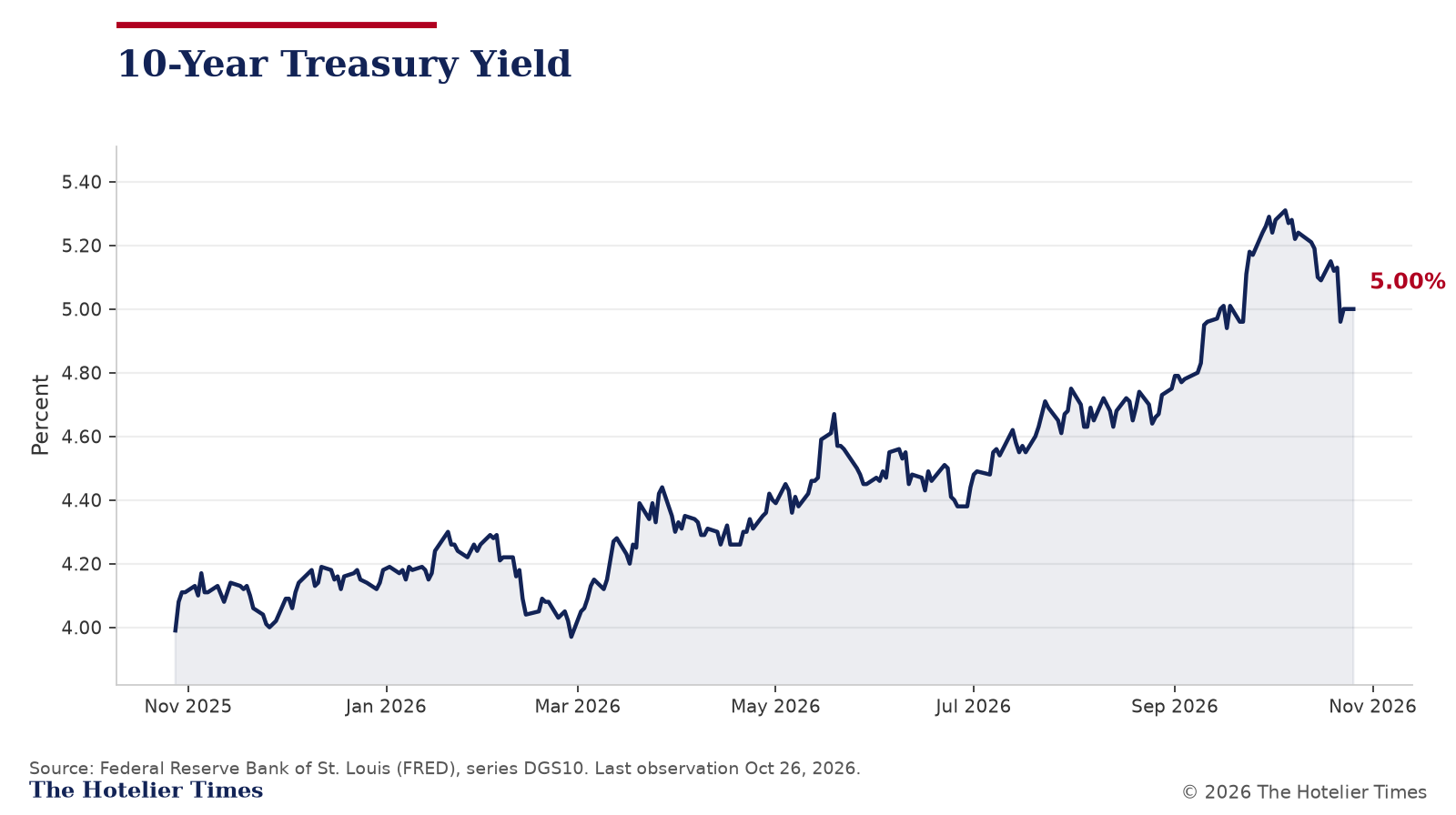
Hotel fixed-rate quotes are typically a spread over Treasuries and track the 10-year more closely than the overnight policy rate. On FRED series DGS10, the 10-year yield’s latest daily close was 5.00% on Oct. 26, 2026. Over the past year it has ranged from about 3.97% to 5.31%. U.S. Treasury’s par curve showed 4.99% on Oct. 27 and 5.00% on Oct. 26. After Wednesday’s decision and press conference, the 10-year was about 5.04%–5.05% and the 2-year about 4.70%–4.73% as of about 2:00–2:11 p.m. CT (CNBC Treasuries). SOFR was 3.93% on Oct. 26 (New York Fed).
Lodging CMBS stress was already rising before today’s decision: Trepp’s lodging CMBS delinquency rate reached 6.18% in September and lodging special servicing 8.95% (Trepp).
Latest weekly hotel data (week of Oct. 11–17): U.S. occupancy 70.7% (+3.1% year over year), ADR $177.65 (+2.3%) and RevPAR $125.53 (+5.5%) (CoStar via Hospitality Net).
CRE market reaction
On the commercial real estate debt side, Mitch Ginsberg, founder of CommLoan, said after the decision: “Holding rates today doesn’t undo what the last two months have done to commercial real estate deals… We’ve seen lenders come back at final loan approval with a higher rate than the one borrowers planned around. With the midterms next week and a December hike largely priced in, that uncertainty isn’t going away.” Newmark estimates that roughly 78% of fixed-rate securitized CRE debt maturing through 2028 carries a rate below the current 10-year Treasury yield (Bisnow, Oct. 28).
Ian Ross, founder and managing principal at SomeraRoad, told Commercial Observer: “We’re late enough in the year and conditions are uncertain enough that most people just put their pencils down… The market just needs a signal of stability and a path so participants have a stable footing to act from.” Patrick McGlohn, senior managing director at Berkadia mortgage banking, said: “We’ve seen a little bit of a jolt from the Treasury run-up and what that’s caused from a credit stance from lenders… It has also driven higher cap costs, so it’s been a little bit of a shock to the system over the past four or five weeks.” (Commercial Observer)
What it means for hotel owners right now
Full Access Pass
Continue reading
Get the rest of this article for 99¢ with a 24-hour Day Pass, or get the Full Access Pass for $1.99/month for every article.
Comments
No comments yet. Start the conversation.