The Last Capped Bill: What Texas Hotel Owners Should Check on This Month’s Property Tax Statement
A new $125,000 exemption on your furniture and equipment, a 20% cap that ends after this year, and a 9.6% higher Harris County rate all land on the same bill.
Every October, Texas appraisal districts' numbers turn into actual bills. The Texas Comptroller says tax bills go out starting in October, most are due by Jan. 31, and anything unpaid on Feb. 1 picks up a 6% penalty and 1% interest, rising to a 12% penalty by July 1, with interest running at 1% a month and no ceiling.
This year's bill is different from last year's in three ways that matter to hotel owners, and one of them comes with an expiration date.
1. Your Furniture Just Got a $125,000 Head Start

Hotels are unusual among commercial real estate: a big chunk of what you own is not the building. Beds, case goods, TVs, PTACs, laundry equipment and the breakfast bar are business personal property, and Texas taxes it.
Until this year the exemption on income-producing personal property was $2,500, which for a hotel meant almost nothing. House Bill 9, signed June 12, 2025, raised it to $125,000 of market value for tax years starting Jan. 1, 2026, according to tax firm Ryan. Texas voters approved the matching constitutional amendment, Proposition 9, on Nov. 4, 2025 (Texas Comptroller).
Two details matter for hotel owners. The exemption generally applies to each location within each taxing unit, so a single-hotel owner should see it once for each taxing unit on the bill (county, city, school district and so on). And related companies' property at the same location is added together, so you cannot split one hotel's FF&E across several LLCs to claim it twice (Ryan).
What it is worth, in a round made-up example: a hotel with $400,000 of taxable FF&E now pays tax on $275,000. At a combined rate of $2.00 per $100 of value, that is $2,500 a year back in your pocket. Small, but it repeats every year, and for an older economy hotel whose furniture is worth less than $125,000, the personal property line may disappear entirely.
What to check: find the business personal property account on your statement (it is usually a separate account number from the real estate) and make sure the exemption shows. Rendition rules changed too: Ryan notes that owners may still need to file a rendition or a short statement certifying the value is under the exemption, and the appraisal district can still ask for a full rendition. Ask your tax consultant or the appraisal district what your county now requires before next April's deadline.
2. The 20% Cap on Your Building Is in Its Last Year
Since 2024, Texas has capped how fast the appraised value of non-homestead real property can rise: no more than 20% a year, plus the value of any new improvements. The Comptroller calls it the circuit breaker limitation. It applies only to property worth $5,320,000 or less in 2026 (the line was $5 million in 2024 and $5,160,000 in 2025, adjusted for inflation), there is no application, and the appraisal district applies it automatically.
That covers a lot of Texas hotels: the 70-room highway hotel, the older limited-service property, the small independent. It covers almost no full-service downtown hotels.
Then it ends. The Comptroller states that the circuit breaker limitation expires Dec. 31, 2026, and the Legislature did not renew it in its 2025 session. The next regular session does not convene until January 2027.
Here is why that matters, again with round made-up numbers. Say your hotel's market value is $4.6 million, but the cap has held its appraised value at $4.0 million. If the cap is not renewed and the value holds, your 2027 taxable value jumps to $4.6 million. At $2.00 per $100, that is $12,000 more tax in one year, with nothing changed at the hotel.
What to check: your appraisal notice or the appraisal district's online record shows both market value and appraised (capped) value. If they differ, the gap is your 2027 exposure. Put it in the 2027 budget now; it is one of the few cost increases you can see a year ahead.
One more rule for buyers: the cap does not transfer. Harris Central Appraisal District says that selling the property removes the limitation and the tax base returns to market value until the new owner qualifies, after a full calendar year of ownership.
3. The Rate Went Up, at Least in Harris County
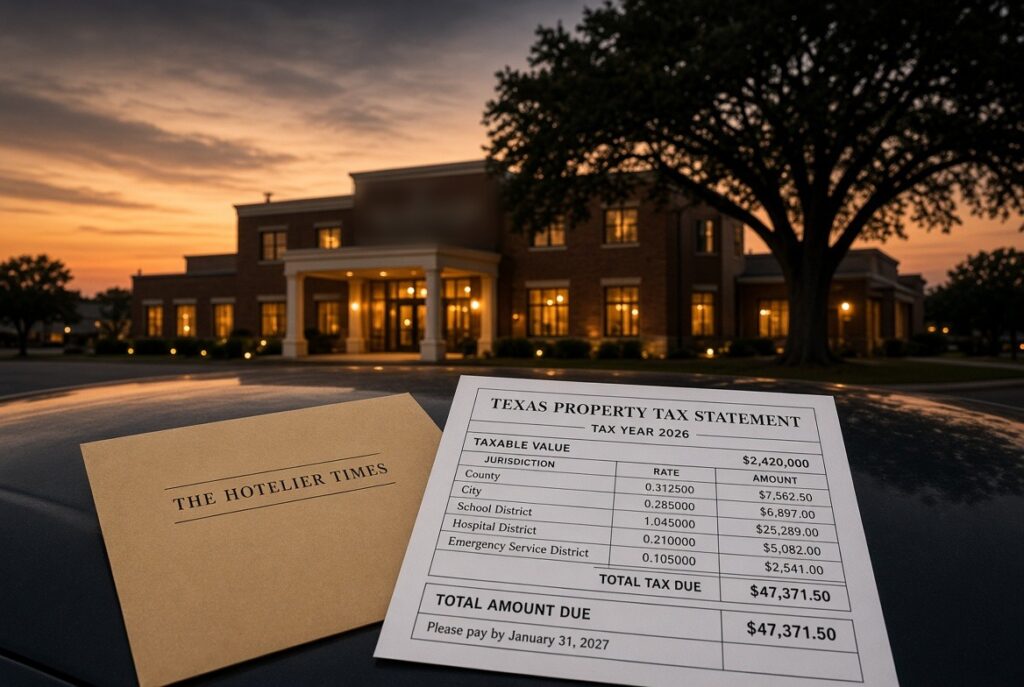
On Sept. 17, Harris County Commissioners Court passed a county rate of $0.41750 per $100 of taxable value, up from $0.38096 in 2025, about 9.6% higher (FOX 26 Houston). The county's combined rates for the entities it controls rise about 7.6%, according to its Office of Management and Budget. Add the Flood Control District ($0.05266), Harris Health ($0.19528) and the Port of Houston ($0.00603) and the county-controlled total is $0.67147 per $100.
On a hotel with a $5 million taxable value, the county rate alone is $20,875 this year versus $19,048 at last year's rate, a $1,827 difference before the city, school district and any other taxing units on the same bill. Owners outside Harris County should look for the same line: compare each taxing unit's rate this year with last year's.
The Bigger Picture: Tax Is Outrunning Profit
This is not just a Texas story. CBRE's Trends in the Hotel Industry survey of 2,216 hotels found that property taxes rose 2.4% across U.S. hotels in 2025, and 12.3% at midscale hotels, while midscale gross operating profit fell 5.7% (Tommy Crozier, CBRE, in LODGING, May 26, 2026). In the South Central region, CBRE's 2024 data put property tax at $2,294 per available room for full-service hotels and $1,071 for limited-service (Desiree Flanary, CBRE, Aug. 29, 2025).
A cost line growing faster than profit is a cost line worth fighting.
How Hotels Get Overvalued, and What to Do Next Spring
Two features of Texas make hotel appraisals easy to get wrong.
First, Texas taxes real estate, not your business. Attorney Oliver Gray of Gray Winston & Hart wrote in REBusinessOnline (Oct. 21, 2025) that assessors must separate taxable land and buildings from a hotel's brand, goodwill and workforce, which are not taxable, and that the common management-fee method can leave some of that business value in the number. Texas law also lets owners argue "equal and uniform" treatment, comparing their value with similar hotels nearby (Tax Code Section 42.26, cited in the same article).
Second, Texas is a non-disclosure state: no law lets appraisal districts make buyers or sellers report sale prices (San Antonio Report). So the district is often estimating, which cuts both ways.
The protest window for the 2026 values has closed; under Texas Tax Code Section 41.44, the deadline is May 15 or 30 days after the notice of appraised value is delivered, whichever is later. So the work now is preparation for 2027:
- Pay this bill on time, or on a planned installment if your county offers one. Penalties start Feb. 1.
- Confirm the $125,000 personal property exemption is on every taxing unit.
- Write down your market value versus capped value. That gap is your 2027 increase if the cap is not renewed.
- Pull your 2025 and 2026 profit and loss statements now. They are the evidence for next spring's protest.
- Watch for the 2027 notice in the spring and calendar May 15. Many owners hire a property tax consultant on a contingency fee; get the fee in writing.
- Buying a Texas hotel? Underwrite next year's tax on the price you pay, not the seller's capped bill.
The Bottom Line
For two years, the circuit breaker has quietly kept thousands of smaller Texas commercial properties, hotels among them, from feeling the full force of rising values. 2026 is the last bill written under it, unless the Legislature acts. The new $125,000 exemption is a real but modest win; the cap's expiration could cost more than the exemption saves. The owners who come out ahead in 2027 will be the ones who read this bill closely now, not the ones who pay it and file it.
This article is general information, not tax or legal advice. Talk to a property tax consultant or attorney about your hotel.
Get the numbers that move hotel values: deals, cap rates and tax changes, every week, free.
Selling a Texas hotel? A buyer will ask what the taxes will be after the sale. List it on Hotels for Sale for $49 a month (founding rate, first 20 listings), then $79 a month. No commission, no success fee.
Sources
- Texas Comptroller, Paying Property Taxes: https://comptroller.texas.gov/taxes/property-tax/pay
- Texas Comptroller, Valuing Property: https://comptroller.texas.gov/taxes/property-tax/valuing-property.php
- Texas Comptroller, Property Tax Today, January 2026: https://comptroller.texas.gov/taxes/property-tax/newsletter/vol35-jan26.php
- Ryan, "Texas Significantly Increases Business Personal Property Exemption" (Sept. 4, 2025): https://ryan.com/ca/fr-ca/perspectives/texas-raises-bpp-exemption-2025
- Harris Central Appraisal District, Circuit Breaker Cap: https://hcad.org/hcad-help/circuit-breaker-cap
- Gill, Denson & Company, "The End of the Texas Circuit Breaker Property Tax Cap" (Aug. 19, 2026): https://gilldenson.com/the-end-of-the-texas-circuit-breaker-property-tax-cap/
- Ownwell, Texas 20% appraisal cap expiration (Sept. 22, 2026): https://www.ownwell.com/blog/texas-20-percent-appraisal-cap-expiration-2027
- FOX 26 Houston, Harris County tax rates (Sept. 17, 2026): https://www.fox26houston.com/news/harris-county-commissioners-final-vote-proposed-tax-rate-increase
- LODGING, "Profitability Under Pressure," Tommy Crozier, CBRE (May 26, 2026): https://lodgingmagazine.com/profitability-under-pressure-how-2025-u-s-hotel-performance-reshapes-valuation-underwriting/
- CBRE, "Navigating the Property Tax Maze," Desiree Flanary (Aug. 29, 2025): https://www.cbre.com/insights/articles/navigating-the-property-tax-maze-how-location-and-hotel-type-impact-your-bottom-line
- REBusinessOnline, "Untangling Hotel Valuation for Texas Property Taxes," Oliver Gray (Oct. 21, 2025): https://rebusinessonline.com/untangling-hotel-valuation-for-texas-property-taxes/
- San Antonio Report, non-disclosure state: https://sanantonioreport.org/disclosing-a-homes-sales-price-what-you-need-to-know/
- Texas Tax Code Sec. 41.44: https://texas.public.law/statutes/tex._tax_code_section_41.44



Comments
No comments yet. Start the conversation.