Vrbo Reserve Now, Pay Later: What Hotel Owners Should Watch
By Nathan Snyder, Editor, The Hotelier Times
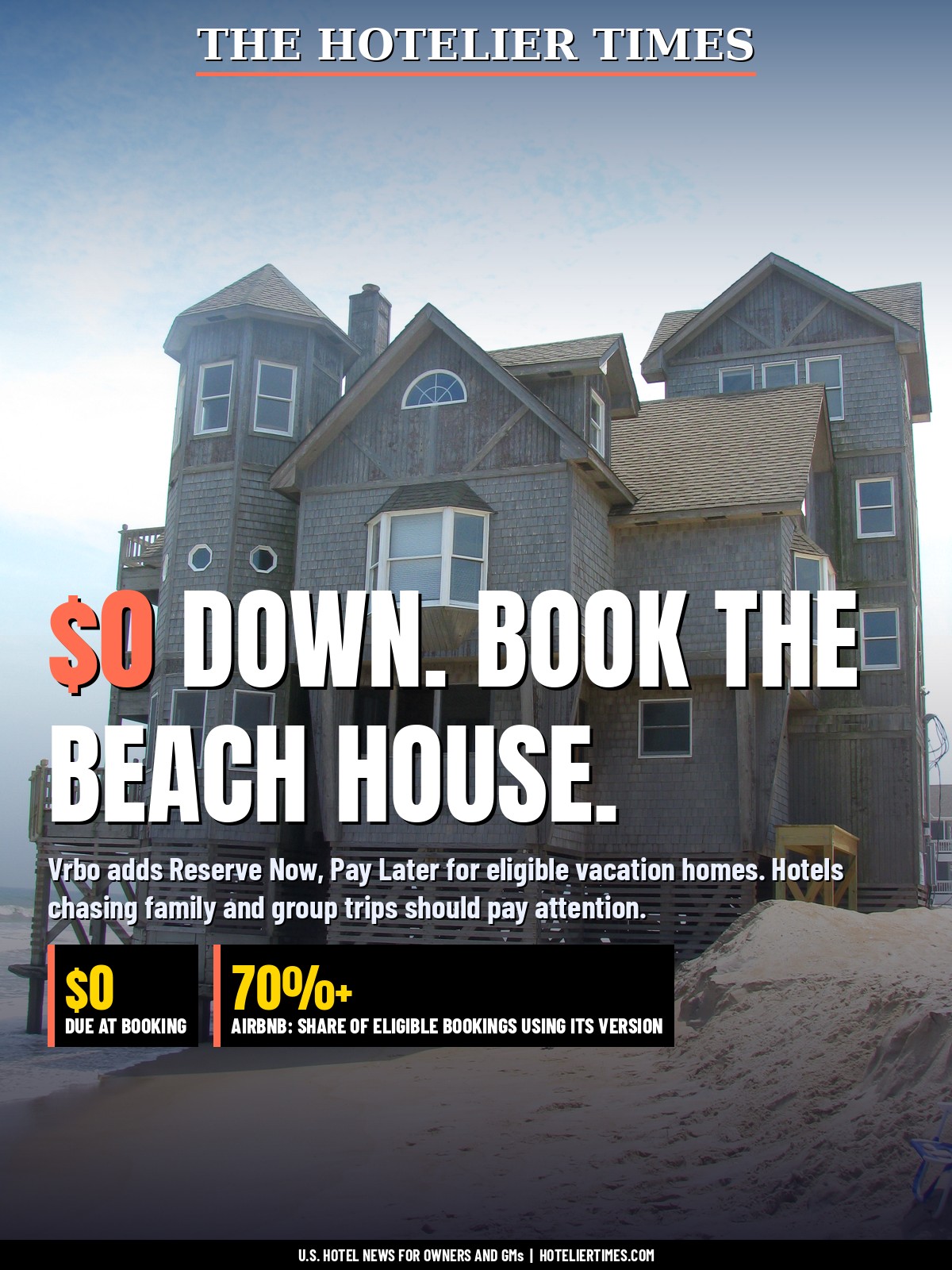
Expedia Group put Reserve Now, Pay Later on Vrbo: $0 due at booking on eligible homes, card on file, full stay charged before the free-cancellation deadline. Expedia’s release still says “coming soon”; Skift says it is already live on Vrbo’s website. For hotel owners, $0 at booking shifts cancellation and cash-flow risk onto hosts and platforms — and forces a choice: match with deferred-pay rates, or defend non-refundable.
On Oct. 28, 2026, Expedia Group’s Fall 2026 Product Release listed Reserve Now, Pay Later among more than 30 features across Expedia, Hotels.com and Vrbo. The press language is explicit: “Coming soon to Vrbo, Reserve Now, Pay Later will allow travelers to reserve eligible homes with $0 due at booking.” The FAQ on the same page says it works “by placing a credit card on file.” Skift’s Dennis Schaal, writing the same day, reported the product is already live on Vrbo’s website, with the app to follow “over the coming weeks,” per Expedia. We are stating that discrepancy outright: Expedia says coming soon; Skift says live on web.
How Vrbo’s $0-at-Booking Product Works
Vrbo’s host-facing Help Center page, “About the Reserve Now, Pay Later option”, sets the rules. A traveler picks Reserve Now, Pay Later at checkout when it is available. Vrbo validates the payment method at booking and schedules the charge. The traveler still owes the full amount; only payment timing changes. The full stay is charged automatically before the free-cancellation deadline.
Eligibility is narrow. The Help page says the product is available for cancellation policies that offer a full refund 60 days or less before check-in: Day Before, Lenient, Relaxed, Moderate, Strict and Firm qualify; No Refund does not. Other factors include payout setup, booking type, booking lead time, point of sale, and a stay of 28 nights or fewer. Not every listing qualifies. Hosts cannot opt out. The only way to make a listing ineligible is to switch it to No Refund — and that change applies to all new bookings on the listing.
If the scheduled payment fails, Vrbo retries, then gives a grace period. If the guest still has not paid by the free-cancellation deadline, Vrbo cancels the booking automatically and reopens the calendar. Host payout timing does not change (typically one business day after check-in). A Reserve Now, Pay Later booking blocks the calendar like any confirmed reservation. Non-payment cancellations do not count against host performance metrics.

Skift vs. Expedia on Timing — and Airbnb’s Track Record
Skift reports that Vrbo charges the card seven days before the host’s free-cancellation window closes, which it says can be 30 or 60 days before check-in. That charge window is Skift’s reporting, not a line in Expedia’s press release. It also sits awkwardly next to Vrbo’s eligibility list: Day Before and Lenient policies are eligible, which implies some charge dates could land much closer to arrival. Attribute the 30- or 60-day framing to Skift until Expedia or Vrbo confirms it in writing.
Airbnb launched a U.S. version on Aug. 14, 2025 and expanded it for Asia Pacific guests booking eligible listings worldwide on Feb. 23, 2026. Guests pay $0 at booking; Airbnb charges the full amount on the date shown at checkout, “shortly before the end of the listing’s free cancellation period,” per Airbnb Newsroom. A guest who cancels before payment is due is not charged, per Airbnb Help article 2143.
Skift, citing Airbnb earnings calls, says adoption sits above 70% of eligible bookings, lead times lengthened, and a shift toward homes with four or more bedrooms lifted ADR. The same Skift report says Airbnb’s cancellation rate rose about 1 percentage point to roughly 17%, and collecting cash later weighed on free cash flow and working capital. Airbnb itself said Reserve Now, Pay Later “helped drive the acceleration of nights and seats booked in Q4 2025 from Q3 2025.” Those 70%+/~17% figures are Skift citing earnings calls — not our audit of Airbnb’s books. Skift also argues Airbnb’s charge can fall as close as 24 hours before arrival, versus 30 or 60 days for Vrbo. If that contrast holds, Vrbo looks more host-friendly on rebooking time and less flexible for guests.
Where Cancellation and Cash-Flow Risk Lands
For Vrbo hosts, the platform holds most collection risk until the charge date. Payout timing does not move just because the guest paid $0 at booking. The calendar is still blocked. If payment fails, the booking dies before the free-cancellation window closes and the dates reopen. That is cleaner for a host than a late cancel after a thin deposit.
The risk that does shift to hosts is opportunity cost. Speculative group bookings — families still confirming who is coming — can occupy inventory a cash-up-front guest would have taken. Airbnb’s earnings-call commentary, as reported by Skift, already showed a measurable cancellation-rate bump. Cash-flow pressure lands hardest on the platform when it floats receivables; Skift made that point about Airbnb. Hotel owners should separate those effects: your deposit policies change your working capital; a competitor’s $0-down product mostly changes who shows up in your leisure competitive set.
Match Deferred Pay — or Defend Non-Refundable?
Hotels already sell pay-at-property and fully refundable rates. What Vrbo is marketing is a louder $0-due framing for group planners coordinating large homes. That competes for multi-bedroom leisure — reunions, wedding-adjacent stays, holiday houses — the same segment many hotels chase with suite blocks and connecting rooms. We covered the owner fight with short-term rentals in Hoteliers vs. Airbnb and Airbnb’s hotel-adjacent moves in Airbnb’s hotel pivot.
Matching means making deferred-pay rates visible on your direct channel and the OTAs that carry your inventory. That can protect conversion when a guest compares your suite block to a Vrbo house advertising $0 due today. The cost is higher cancellation risk and weaker cash collection — the trade Airbnb reported. Defending non-refundable means keeping prepaid inventory as the rate fence for peak weekends, and using refundable or pay-later only where shoulder nights need help. Expedia’s rate-parity fights, which we tracked in our Expedia antitrust coverage, already shape how much flexibility you can show on OTA shelves versus your website. Corporate transient is a different book; see our corporate demand recovery piece. Vrbo matters most if family and group leisure is a real share of your mix.

What This Means for Your Hotel
Full Access Pass
Continue reading
Get the rest of this article for 99¢ with a 24-hour Day Pass, or get the Full Access Pass for $1.99/month for every article.




Comments
No comments yet. Start the conversation.