$116 Brent: What a Six-Month Oil High Does to Your Drive-In Guest, Your Energy Bill and Your 2027 Budget
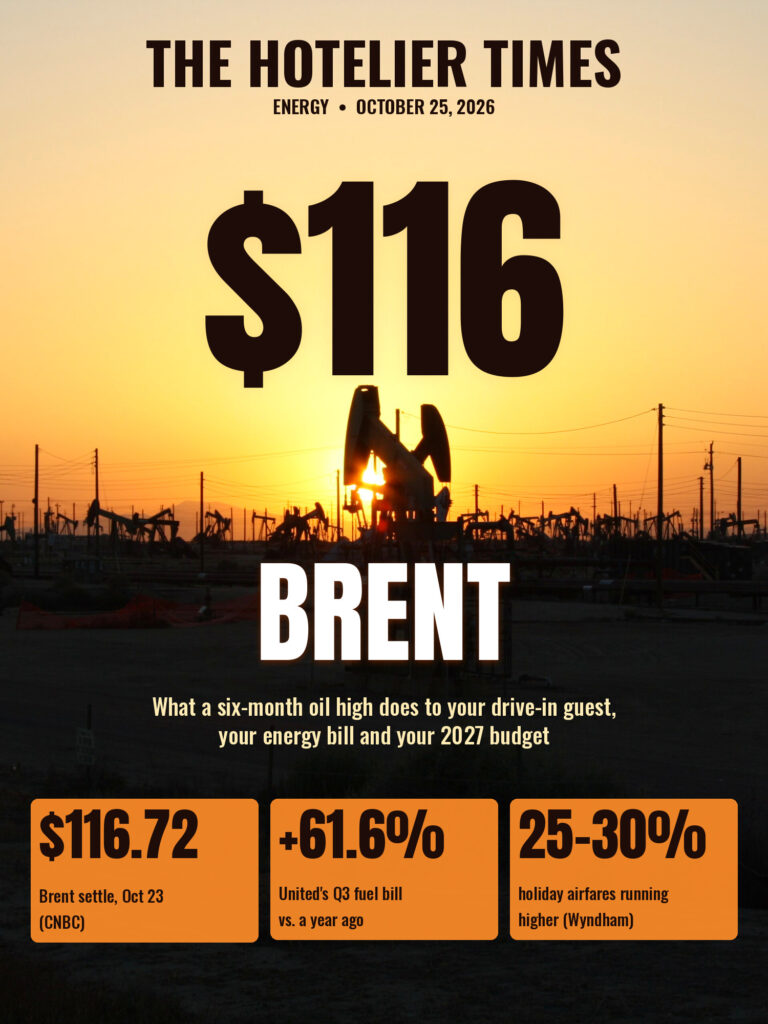
Brent crude settled at $116.72 a barrel on Friday, Oct. 23, its highest close in six months, and the Fed meets this week. Expensive oil helps some hotels and hurts others: it pushes guests into cars and toward drive-to hotels, raises airfares for fly-in resorts, and adds cost to your energy and supply bills. Here is how to plan for it.
Oil prices move fast. The figures below are as of Friday’s close; check the current price before you act on them.
The Numbers
As of Friday’s close, Brent was up 3.1% on the day at $116.72, its highest settle since April 29, CNBC reported. U.S. crude (WTI) settled at $103.27. Brent rose 6.2% for the week, its third straight weekly gain. The drivers, per CNBC: expected U.S. strikes on Iran and Houthi attacks on Saudi Arabia, including the evacuation of Saudi Aramco’s Dhahran headquarters. Reuters had already noted on Oct. 20 that oil was “holding above $100 as the war shows no signs of easing.”
Who Wins: The Drive-To Hotel
Hotel companies are already seeing guests swap planes for cars. On Wyndham’s Oct. 22 earnings call, CEO Geoff Ballotti said airfares were “running 30% ahead for Thanksgiving, 25%… for Christmas. People are driving.” He said demand had held up despite elevated gas prices. Those are Wyndham’s figures, as described on the call, not a national airfare statistic.
IHG CEO Elie Maalouf made the same point, Reuters reported: many of its U.S. customers drive to hotels rather than fly, which cushions them from higher airfares.
The winners are drive-to hotels: highway and select-service properties and regional leisure destinations within a tank of gas of big cities. When holiday airfares run 25% to 30% higher, as Wyndham says they do, a three-hour drive to a hotel you can reach by car looks better.
Who Loses: The Fly-In Resort
The mechanism runs through the airlines’ fuel bill. United said its aircraft fuel expense rose 61.6% in the third quarter, to $4.84 billion from $3.0 billion, as its average fuel price rose to $3.90 a gallon from $2.43. United still posted record revenue, up 17% to $17.9 billion, and yield per passenger mile rose 16.8%. Higher fares, in other words, are how the fuel bill reaches the traveler.
If your hotel depends on guests who fly in, such as island and destination resorts, long-haul leisure and some convention business, higher fares are a headwind. Reuters cited “high airfares and elevated borrowing costs” among the factors clouding the outlook for travel companies.
The Cost Side: Your Energy, Laundry and Freight
Oil does not stay at the airport. It shows up in your utility bill, especially where gas sets power prices; in your linen and laundry contracts; in food and beverage freight; and in anything that arrives on a truck. We have not seen a reliable 2026 dataset on hotel energy costs, so we are not putting a percentage on it. But if you run a full-service hotel with big HVAC, kitchens and laundry loads, your exposure is real.
Reuters put it more broadly: the rising cost of living is “driven by higher energy costs as a result of President Donald Trump’s war with Iran, as well as new tariffs.” Economists in its poll expect PCE inflation to stay above target until at least 2028.
The Rate Side: A Hold Now, a Hike Expected in December
The Federal Reserve meets Tuesday and Wednesday, Oct. 27–28. It raised rates by 25 basis points in September, to a target range of 3.75% to 4.00%. In a Reuters poll published Oct. 20, 94 of 100 economists expected a hold this week, and all 100 expected a hike in December. Nearly 60% saw rates peaking at 4.00% to 4.25%.
Long-term rates matter too. The 10-year Treasury yield rose back above 5% on Friday, according to Skift’s Daily Lodging Report. Even asset-light brands feel it: IHG warned of a $40 million to $60 million increase in its 2027 interest costs, Reuters reported. If you carry floating-rate debt or face a maturity in 2027, see The Refi Clock and The Maturity Date Is the Default.
Build an Oil Line Into Your 2027 Budget
In our 2027 budget analysis, we argued that next year’s revenue forecast won’t cover next year’s bills. Oil adds another cost risk to that gap. You can’t forecast the price of oil, and neither can we. What you can do is show your owners or lenders what happens to margin if energy and freight costs rise, and what you will do about it.

What This Means for Your Hotel
- Add an energy scenario to the 2027 budget. Run a base case plus two stress cases, for example utility and freight costs up 15% and up 30%, and show ownership the margin impact. These are planning scenarios, not forecasts.
- Market to your drive radius. Push packages for drive markets 150 to 300 miles away for Thanksgiving and Christmas: parking, late checkout, a fuel card.
- Lock in energy where you can. Ask your utility broker about fixed-price electricity and natural gas contracts for 2027 now, before the next move.
- Review floating-rate debt. Price a rate cap or an extension before a December hike, and model your debt service coverage at 25 to 50 basis points higher.
- Cut energy waste this month. Set back HVAC in unsold rooms, finish LED and occupancy-sensor retrofits, and run laundry off-peak. These pay back faster when prices are high.
The Bottom Line
Expensive oil splits the hotel business. Drive-to hotels can win guests who would have flown, while fly-in resorts face pricier airfares and every hotel faces higher energy and supply costs. Add a Fed that raised rates in September and is expected to do it again in December, and the playbook is simple: sell to the drive market, lock in what costs you can, and put an energy line in your 2027 budget before your lender asks for one.
Oil prices and rate expectations are as of Friday, Oct. 23, and Reuters’ Oct. 20 poll. Check current figures before making decisions.
Sources and further reading
- Brent crude oil tops $116, a six-month high, as tensions swell in the Middle East — CNBC, 2026-10-23
- Fed to skip October but raise rates again in December, nearly all economists say: Reuters poll — Reuters via Investing.com, 2026-10-20
- United delivers record 17% revenue growth in Q3 — United Airlines, 2026-10-20
- Wyndham Hotels (WH) Q3 2026 earnings call transcript — The Motley Fool, 2026-10-22
- Holiday Inn owner IHG beats revenue estimates on resilient US travellers — Reuters via Euronext, 2026-10-22
- Kalibri CEO Says Corporate Hotel Demand Up for First Time Since Pandemic — Skift Daily Lodging Report, 2026-10-23
- The Refi Clock: 596 Hotel Loans, $18.7 Billion, and a Fed That Just Raised Rates — The Hotelier Times, 2026-10-07
- The 2.1 Percent Budget — The Hotelier Times, 2026-10-07





Comments
No comments yet. Start the conversation.