Cheaper Wind, Pricier Lawsuits: The Hotel Insurance Market Hurricane Isaias Just Walked Into
Click to listen to the audio version of this article.
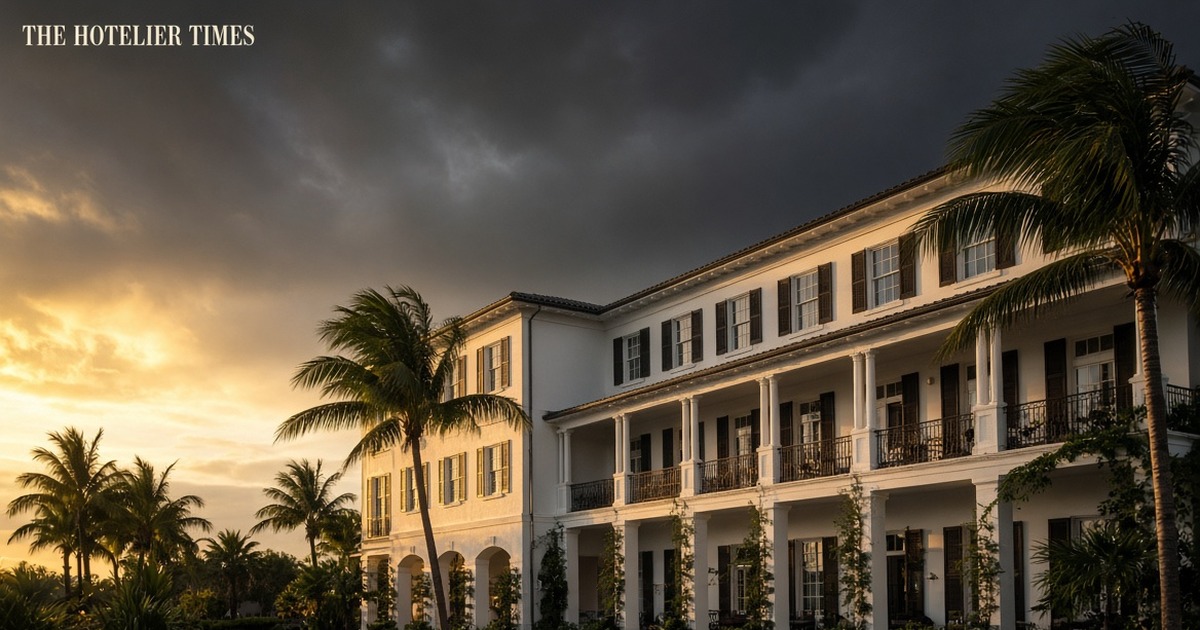
Hotel property premiums fell all year. Liability premiums did not. Now the season's first hurricane has come ashore, and owners need to know which number to budget around.
Our thoughts are with everyone on the Gulf Coast affected by Hurricane Isaias, and with the families of the at least four people killed in Alabama and Florida, according to state and local officials.
Isaias came ashore near Destin, Florida, on Friday evening, Oct. 9, as a Category 2 hurricane with maximum sustained winds of about 105 mph, after briefly reaching Category 3 strength earlier in the day. Gusts reached 116 mph on Santa Rosa Sound, the National Weather Service reported. At the peak on Saturday morning, more than 880,000 customers had lost power across Florida, Alabama and Georgia, CBS News reported, and in Pensacola the wind tore the roof off a hotel. Tens of thousands of people evacuated ahead of the storm, and Alabama ordered visitors out of Baldwin County's beach towns, including Gulf Shores and Orange Beach, on what should have been a busy tourist weekend. The storm weakened to post-tropical early Saturday as it moved inland.
It is the season's first hurricane, and it arrived in October. That timing matters for every hotel owner with a renewal on the calendar, because the quiet stretch before it is one of the reasons insurance got cheaper this year.
The Property Market Finally Broke the Owner's Way
For three years, the property line on a hotel's insurance bill only went one direction. CBRE found that hotel insurance premiums grew 17.4% in 2024, the same year total hotel revenue grew 2.3% (CBRE Hotels Research, May 2025). Risk Strategies' 2025 State of the Hospitality Insurance Market report put property rate increases at 17% to 26% on average depending on the state, and 50% or more for high-risk locations, older buildings and businesses with recent losses.
Then the market turned. Marsh's Global Insurance Market Index for the second quarter of 2026 shows U.S. commercial property rates down 13% (Marsh, July 23, 2026). For hotels specifically, the wholesale broker Amwins reported that hotels "in favorable geographies" are commonly seeing "premium reductions in the range of 15% to 25%," after earlier renewal cycles that brought increases that "in some cases, exceeded 150%" (Amwins, State of the Market 2026: A Focus on Hospitality, July 13, 2026). The Baldwin Group says non-catastrophe-exposed hotels with clean loss histories are seeing mid-single-digit to low-double-digit reductions, with bigger cuts possible for clean coastal properties in shared and layered programs (Baldwin, July 29, 2026).
The reasons are not mysterious. Insurers are making money again: Baldwin cites property insurers' combined ratios improving from 101.6 in 2023 to 97.1 in 2024 and 95.0 in 2025. Capacity has come back. And, as Amwins put it, the 2025 season "didn't see any hurricanes make landfall in the continental U.S."
"Property insurance has softened considerably, with increased capacity, broader terms, and rate reductions," said Dana Fansler, program manager at Amwins Program Underwriters (Insurance Journal, Sept. 7, 2026).
The Other Half of the Bill Is Going the Other Way
Here is the part that does not make the renewal email subject line. In the same Marsh index, U.S. casualty rates rose 7% in the second quarter, after 9% in the first. Property fell; liability kept climbing.
For hotels, Baldwin reports general liability increases from modest to low double digits even for operators with good loss records, and low-double-digit increases on umbrella and excess. Operators with bad loss histories pay significantly more. Lockton reported in February that lead umbrella layers of $5 million are now common and that some insurers will only offer $2 million (Lockton, February 2026).
What is driving it is the courtroom. Slip, trip and fall claims remain the biggest source of hospitality liability losses and "routinely produce settlements in the high six- to seven-figure range," according to Amwins. Baldwin notes that the first reported jury trial of a federal sex trafficking (TVPRA) claim against a hotel, in July 2025, ended in a $40 million award to the plaintiff. Underwriters now ask to see anti-trafficking policies, employee training records and reporting procedures before they quote.
The quieter change is in the fine print. Fansler said carriers are "applying sub-limits, requiring separate coverage grants, moving defense costs inside policy limits, or excluding certain exposures entirely," and that coverage for assault and battery, abuse and molestation, and human trafficking can now be full, reduced or gone. "Many insureds focus on price and limits but fail to review A&B, SAM, trafficking," she said.
Put the two lines together and the math looks like this. Take a hypothetical hotel paying $250,000 a year for property and $100,000 for liability. A 15% to 25% property cut saves $37,500 to $62,500. A 7% liability increase costs $7,000. The owner is still ahead by $30,500 to $55,500, but only if the liability policy still covers what it covered last year.
What Isaias Does to the Math
It is too early to know what Isaias will cost, but the reinsurance brokers who help set the market's prices have put out first estimates, all made before landfall. BMS put expected insured losses at $4 billion to $6 billion and said they "should be below $10B," while Gallagher Re, Marsh Re and Twelve Securis each landed in the mid-single-digit billions, Artemis reported on Oct. 9. Gallagher Re said it does not expect the losses to "meaningfully" influence January 1 reinsurance renewals because of "the abundance of available reinsurance capital" (Business Insurance, Oct. 9), and BMS said the storm "does not seem to materially affect current capacity or the softer market conditions." Moody's counted 31,659 commercial properties in Alabama, Florida and Mississippi, worth an estimated $71.8 billion, with better-than-even odds of facing winds of at least 50 mph, and named Mobile, Pensacola and Biloxi as the most exposed cities (Insurance Business, Oct. 9). In plain terms: the market as a whole looks able to absorb Isaias, but an individual carrier will remember whether your hotel filed a claim. Amwins had already warned that "catastrophe-prone portfolios may still encounter higher deductibles" and that wind and hail "still affect underwriting outcomes" from the Gulf Coast through the Midwest.
For hotels outside the damage zone, a storm can mean the opposite of a loss. When Hurricane Milton hit Florida in October 2024, CoStar reported Atlanta occupancy up 15.6% to 77.5% and RevPAR up 20.6% that week "due to displacement demand from Hurricane Milton," while Tampa RevPAR fell 9.8% (CoStar, Oct. 17, 2024). Inland hotels in Alabama, Mississippi and the Florida Panhandle may see the same pattern this month, and the weekly numbers on our U.S. Hotel Performance page will show it.

Six Things to Check, This Week or at Renewal
- Find your named-storm deductible. It may be written as a percentage of insured value rather than a flat dollar figure, so look at your declarations page, not your memory. On a hypothetical hotel insured for $15 million, a 3% deductible is $450,000, or $4,500 a key for a 100-room hotel, before the policy pays a dollar.
- Document before you clean. Florida's Department of Financial Services tells storm victims to take photos, video or written notes of the damage, to make emergency repairs that prevent further damage and document them, and to report damage to the agent or insurer (Florida CFO, Aug. 25, 2026).
- Do not sign in a hurry. The same office warns: "Don't rush into signing a contract with an adjuster," verify the license of any contractor or adjuster, and remember that public adjusters are paid a percentage of what they recover. Its consumer helpline is 1-877-MY-FL-CFO.
- Keep your daily numbers. If you have business interruption coverage, the claim lives or dies on revenue records. Save the daily reports from before, during and after the storm, including the rooms you could not sell.
- Update your property valuation before renewal. Amwins says carriers are "increasingly sensitive to outdated property valuations." A soft market is the cheapest time to fix an old number.
- Read the liability exclusions line by line. Ask your broker in writing whether assault and battery, abuse and molestation, and human trafficking are covered in full, sub-limited or excluded, and whether defense costs sit inside or outside the limit. Then document your trafficking-awareness training, because the underwriter will ask.
The Bottom Line
Hotel owners finally got a year where the biggest line on the insurance bill came down, by as much as a quarter in the right places. The temptation is to bank all of it. The better move is to spend part of the savings where the market is still hard: a deductible buyback on the coast, a bigger umbrella, or a closer read of the liability exclusions that are quietly shrinking. Property rates fell because nothing hit. Isaias is the reminder that the quiet years are the ones that get priced in.
Sources
- CBS News, Isaias live updates (Oct. 11, 2026): https://www.cbsnews.com/live-updates/isaias-southeastern-u-s-gulf-coast/
- FOX Weather, "Post-tropical Isaias leaves at least 4 dead in Southeast" (Oct. 10, 2026): https://www.foxweather.com/weather-news/hurricane-isaias-landfall-destructive-winds-life-threatening-flooding
- Marsh, Global Insurance Market Index Q2 2026 (July 23, 2026): https://www.marsh.com/en/about/media/global-commercial-insurance-falls-6-percent-q2-2026.html
- Amwins, State of the Market 2026: A Focus on Hospitality (July 13, 2026): https://www.amwins.com/resources-and-insights/market-insights/article/state-of-the-market-2026–a-focus-on-hospitality
- Insurance Journal, "Hotels, Restaurants See Favorable Property Market But Casualty Still Challenging" (Sept. 7, 2026): https://www.insurancejournal.com/magazines/mag-features/2026/09/07/883941.htm
- The Baldwin Group, 2026 Real Estate and Hospitality mid-year state of the market (July 29, 2026): https://baldwin.com/insights/hospitality-industry-report/
- Lockton, Real Estate and Hospitality Market Update (February 2026): https://insights.lockton.com/real-estate-and-hospitality-market-update/february-2026/
- CBRE, "All Eyes on Operating Costs in 2025" (May 8, 2025): https://www.cbre.com/insights/articles/all-eyes-on-operating-costs-in-2025
- Risk Strategies, 2025 State of the Hospitality Insurance Market: https://www.risk-strategies.com/hubfs/25%20State%20of%20the%20Hospitality%20Insurance%20Market.pdf
- Artemis, Isaias insured loss estimates (Oct. 9, 2026): https://www.artemis.bm/news/hurricane-isaias-forecast-to-hit-cat-3-then-weaken-single-digit-billion-insured-losses-still-likely/
- Business Insurance, "Expected Isaias losses unlikely to tip the market: Brokers" (Oct. 9, 2026): https://www.businessinsurance.com/expected-isaias-losses-unlikely-to-tip-the-market-brokers/
- Insurance Business, "Isaias puts $71.8 billion in Gulf Coast commercial property in its path" (Oct. 9, 2026): https://www.insurancebusinessmag.com/us/news/catastrophe/isaias-puts-71-8-billion-in-gulf-coast-commercial-property-in-its-path-593000.aspx
- Florida Department of Financial Services, CFO press release (Aug. 25, 2026): https://myfloridacfo.com/news/pressreleases/press-release-details/2026/08/25/chief-financial-officer-and-state-fire-marshal-blaise-ingoglia-visits-palm-beach-county-on-eighth-stop-in-statewide-hurricane-preparedness-tour
- CoStar, "U.S. hotel occupancy exceeds 70% in mid-October" (Oct. 17, 2024): https://www.costar.com/article/970646028/us-hotel-occupancy-exceeds-70-in-mid-october




Comments
No comments yet. Start the conversation.