The Server Farm Next Door: Why Data Centers and Factory Builds Are the New Demand Generator for Select-Service Hotels
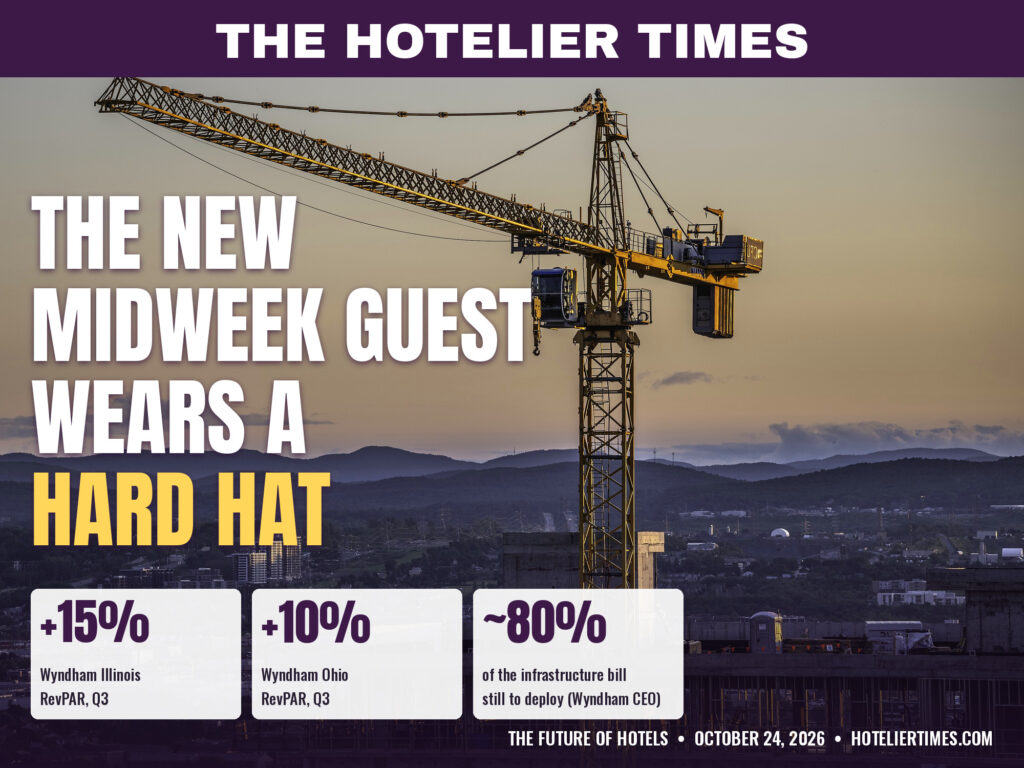
Wyndham says its roughly 1,000 hotels in the markets around 350 data centers it is tracking have seen “a couple of 100 basis points” of RevPAR growth this year, and its Iowa hotels grew RevPAR 16% in the third quarter. The guest behind those numbers wears a hard hat, lives on a per diem and stays for weeks. Here is how to win that guest without betting your hotel on a construction schedule.
Picture a Sunday night at an interstate select-service hotel in the Midwest. Four pickup trucks pull in, and a crew of electricians checks in for a three-week stay. They will be gone by 5 a.m. Monday and back by 6 p.m., Monday through Friday, until the job is done. (This scene is illustrative, not a specific hotel.)
On Wyndham’s third-quarter call on Oct. 22, that guest got a number attached to it.
What Wyndham Disclosed
Wyndham’s U.S. RevPAR rose 6% in the third quarter, and its release credited “sustained strength across the Midwest.” Its investor presentation, as reported by Hotel Dive, says Wyndham has more than 550 hotels within a 10-mile radius of data-center and infrastructure projects. CEO Geoff Ballotti said the portfolio is “well-positioned to benefit from increasing infrastructure-related demand,” driven in part by data-center expansion.
On the call, Ballotti went further. According to the published transcript, he said Wyndham has “about 350 data centers that we are circling that are around approaching 1 thousand of our hotels in those markets,” which have “seen a couple of 100 basis points of RevPAR growth this year.”
Read those two figures carefully. The 550 is the presentation’s count of hotels within 10 miles of projects. The 350 projects and roughly 1,000 hotels are Wyndham’s call-time description of hotels “in those markets,” taken from an automated transcript. They measure different things, so don’t add them up or swap one for the other.
One more caveat: every hard number in this story comes from Wyndham. No third-party dataset we have found isolates RevPAR for hotels near data centers. Treat the figures as one large franchisor’s view of its own system.
The Map: Iowa +16%, Illinois +15%
Wyndham named the states where midweek demand jumped in the third quarter, citing projects in “transportation, manufacturing, AI, data center, and industrial” work. Its RevPAR growth by state:
- Iowa: +16%
- Illinois: +15%
- Ohio: +10%
- Indiana: +9%
Compare that with Wyndham’s 6% for the whole U.S. system. Note what Wyndham did not say: it did not credit those gains to data centers alone. Factories, transportation and other industrial projects are in the mix. Ballotti also said hotels serving the TSMC semiconductor project in Arizona saw “big double digit increases.”
You can see the same industrial pattern in market data. In CoStar’s week of Oct. 11–17, Detroit’s RevPAR rose 20%, helped by the Battery Show, an EV and industrial trade event. That is a trade show, not a construction crew, but it points the same way: industrial money is moving hotel demand. If you own in Texas, our Houston market page covers how that city is being named as an AI and data-center market.
Who This Guest Is
Ballotti described the crews this way: they “operate on strict per diems,” which ends up “anchoring them to our select service brands.” That one sentence tells you most of what you need to know:
- Rate: set by a per diem, not by your revenue system. The crew will book the best hotel that fits the allowance.
- Pattern: midweek, Sunday or Monday through Thursday or Friday, often for weeks at a time. That fills the nights leisure guests leave empty.
- Buyer: often not the guest. Contractors, crew coordinators and brand sales teams place the business.
That last point is where brands are pushing. Wyndham said its Global Sales Organization booked 16% more revenue in the third quarter than a year earlier, up from 12% growth in the second quarter, and that it placed infrastructure business into “almost 6 thousand” hotels. Hotel Dive reported that Wyndham’s weekday strength came from government demand and everyday business travel.
The Tailwind Behind It
This is not only a Wyndham story. On its July earnings call, Hilton told analysts it expected U.S. RevPAR to benefit from “increased private sector investment in the AI complex and ongoing public infrastructure spending.” Reuters, reporting its Oct. 20 economists’ poll, said second-quarter GDP grew at a 2.2% annualized pace, “boosted in large part by AI-driven investment.”
Ballotti argued the runway is long, saying there is “nearly 80% of the infrastructure bill yet to be deployed.” That is his claim, not an audited figure, but it explains why Wyndham is pitching this demand to investors as a multi-year theme.
The Catch: Every Build Has an End Date
Here is the risk, and it is our analysis, not Wyndham’s. A data center employs a construction army for a few years and a much smaller staff once it is running. When the build ends, the crews move to the next site. A hotel that sells out midweek during construction can fall back to its old numbers within a quarter.
That matters most when money changes hands. A buyer or lender looking at your trailing 12 months may be underwriting a construction boom as if it were permanent. If you are the seller, that works in your favor. If you are the buyer, or the owner signing a 10-year franchise renewal and a PIP because the last 18 months looked great, it may not.
Build the Product for the Hard Hat
Crew business also asks for a different hotel. Our suggestions for owners near a build site: truck and trailer parking, a grab-and-go breakfast that opens before 5 a.m., guest laundry, a place to store gear, and flexible housekeeping for long stays. None of that is expensive. Most of it is a policy change, not a PIP.
What This Means for Your Hotel
- Map every project within 10 miles. Check county permit filings, utility interconnection requests and economic-development announcements for data centers, plants, substations and highway jobs. Note each one’s expected construction end date.
- Call the contractors now. Reach general contractors and crew-housing coordinators before the crews arrive. Offer a negotiated rate inside the per diem, with a minimum stay and weekly invoicing.
- Ask your brand’s sales team for leads. If your franchisor has a national sales group placing infrastructure business, make sure your hotel is on its list.
- Cap the crew share. Set a ceiling on how much of your inventory goes to crew contracts, for example 40% to 50%, so you keep room for higher-rated transient guests. Track the mix weekly.
- Underwrite the exit. Before you refinance, buy or sign a long renewal on today’s numbers, model your RevPAR without the project after its end date.
The Bottom Line
The AI build-out has a hotel guest, and for now it is a per-diem crew in a select-service room, not an executive in a suite. Wyndham’s numbers say that guest is already moving RevPAR in the Midwest. Sell to them hard, design for them cheaply, and never value your hotel as if the crane will stay forever.
Sources and further reading
- Wyndham Hotels (WH) Q3 2026 earnings call transcript — The Motley Fool, 2026-10-22
- Wyndham Hotels & Resorts Reports Strong Third Quarter Results — Wyndham, 2026-10-21
- Wyndham posts Q3 US RevPAR gains amid ‘healthier’ demand trends — Hotel Dive, 2026-10-22
- Wyndham rides data center demand as hotel earnings season opens — Skift Daily Lodging Report, 2026-10-22
- U.S. hotel results for week ending 17 October — CoStar
- Fed to skip October but raise rates again in December, nearly all economists say: Reuters poll — Reuters via Investing.com, 2026-10-20
- Hilton Q2 2026 earnings call transcript — Hilton via PublicNow, 2026-07-28
- Houston Hotel Market 2026 — The Hotelier Times




Comments
No comments yet. Start the conversation.