+Hyatt’s 5.95% Notes and Fed Hike Talk: Your 2027 Debt Bill
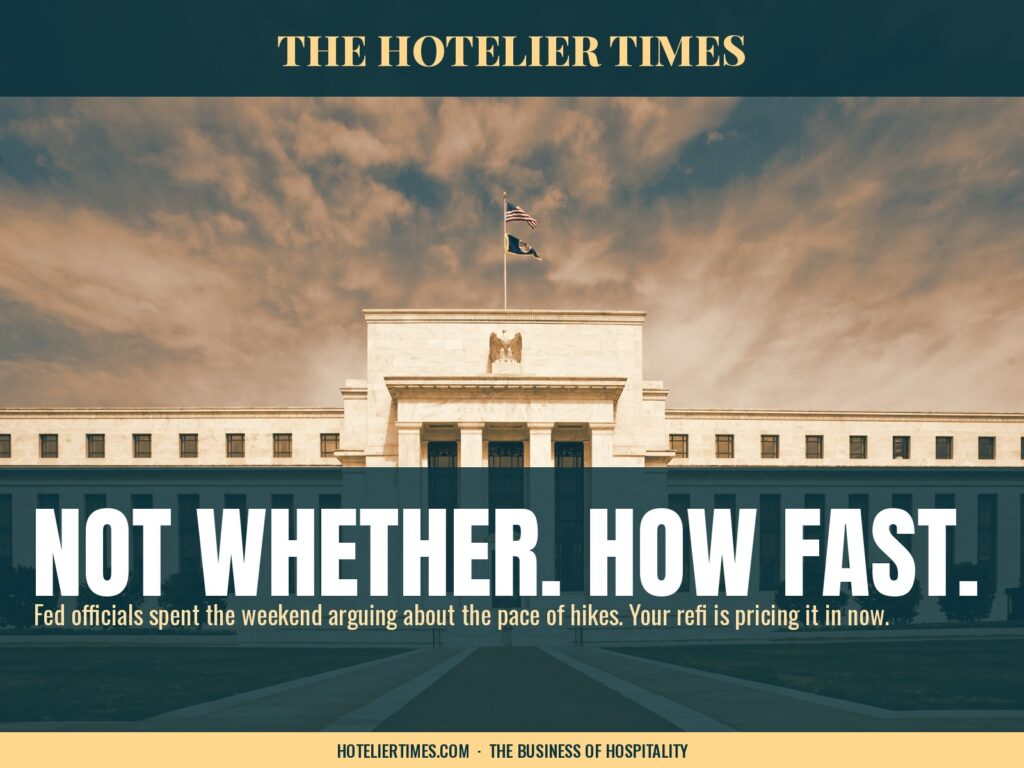
In brief: Fed officials spent the weekend debating how fast to raise rates, not whether. Hyatt’s $400 million of 5.950% notes due 2033 give owners a real-world benchmark for what borrowing now costs.
Hyatt Hotels Corporation issued $400 million of 5.950% senior notes due Nov. 15, 2033, on Nov. 12, after pricing the deal Nov. 2 at a 6.005% yield, 123 basis points over the benchmark Treasury, according to its pricing term sheet filed with the SEC. In an 8-K filed Nov. 12, Hyatt said it received about $395.3 million in net proceeds and “intends to use the net proceeds from the Offering, along with excess cash, to repay all of the 5.750% notes due 2027 … at or prior to their maturity on January 30, 2027 and for general corporate purposes.”
Read that plainly: an investment-grade hotel company is replacing 5.75% money with roughly 6% money. If that is the price of seven-year unsecured debt for a company rated Baa3 by Moody’s and BBB- by S&P and Fitch, it is a useful marker for every owner budgeting 2027 interest costs.
The numbers owners need this morning
- Hyatt notes: $400 million, 5.950% coupon, 6.005% yield, Treasury + 123 bp, priced Nov. 2, issued Nov. 12 (SEC term sheet)
- 10-year Treasury, official Friday close: 5.15%; 2-year 4.88% (U.S. Treasury)
- 10-year Treasury, early Monday: 5.131%; 2-year 4.85% (CNBC)
- Hike odds: 67% for a cumulative half point by January, per CME FedWatch as cited by Reuters on Friday (via Business Recorder)
- Next event: Fed Chairman Kevin Warsh speaks at 11 a.m. CT today (Fed calendar)
Collins: a “steady, gradual path”
Boston Fed President Susan Collins told reporters Saturday at her bank’s housing conference that “a steady, gradual path seems appropriate to me at the moment. But I’m open-minded,” CNA reported, with CNBC carrying the same remarks. She also said recent price data and a stronger labor market “does make me think that the path of policy rates over the, you know, next year might be a bit higher than I had thought a couple of months ago.”
That is the shape of the debate. Collins did not call for a half-point move in December, and she did not rule one out. A preference for gradual hikes now and a higher path over the next year are not opposites. For an owner with floating-rate debt, both mean the same thing: higher interest costs for longer.
Schmid: “some work to do on inflation”
On Sunday, Kansas City Fed President Jeff Schmid said inflation is “uncomfortably above the 2% price stability target, and moving in the wrong direction,” and that the Fed “has some work to do on inflation,” CNBC reported. CNBC noted that Schmid is not a voting member of the Federal Open Market Committee this year and did not specifically call for additional hikes. He also said inflation would still be running near 3% with energy prices set aside, investingLive reported, citing Reuters.
What the bond market already priced
Markets have moved ahead of the speeches. As of Friday, Reuters, citing CME FedWatch, put the odds of a cumulative 50 basis points of hikes by January at 67%, up from 16% a week earlier, and the odds of 75 basis points by March at 48%, up from 6%. Those are Friday’s readings, not a live Monday print. On Monday morning, CNBC reported that markets have largely priced in a quarter-point hike in December.
Long rates have moved too. On Nov. 2, the day Hyatt priced its notes, the official 10-year Treasury close was 4.91%. By Friday, Nov. 13, it was 5.15%, according to Treasury data. That is a 24-basis-point rise in under two weeks, by our math. A similar bond priced today would not automatically clear at Hyatt’s yield or spread, and Hyatt’s number may already look cheap.



Comments
No comments yet. Start the conversation.