+Nuveen Closes a $44 Million C-PACE Loan to Convert Miami Beach’s Monroe Into an 89-Key Hotel
Most hotel owners think of the property tax bill as the one piece of paper that only ever takes money away. In Florida it arrives every November, it is not up for negotiation, and it gets paid ahead of nearly everything else. That last part is the whole secret. A bill that gets paid ahead of nearly everything else is, to the right kind of lender, one of the safest places in the world to put money.
Which is how a historic building on Collins Avenue ended up with a $44 million loan that will be repaid, in effect, through its tax bill. Nuveen Green Capital closed $44 million in C-PACE financing for The Monroe Hotel in Miami Beach, which is being converted into an 89-key boutique hotel, Hotelrealtor.biz reported on Nov. 13. The financing is fixed-rate, long-term and non-recourse, and it was administered by the Florida Development Finance Corp.
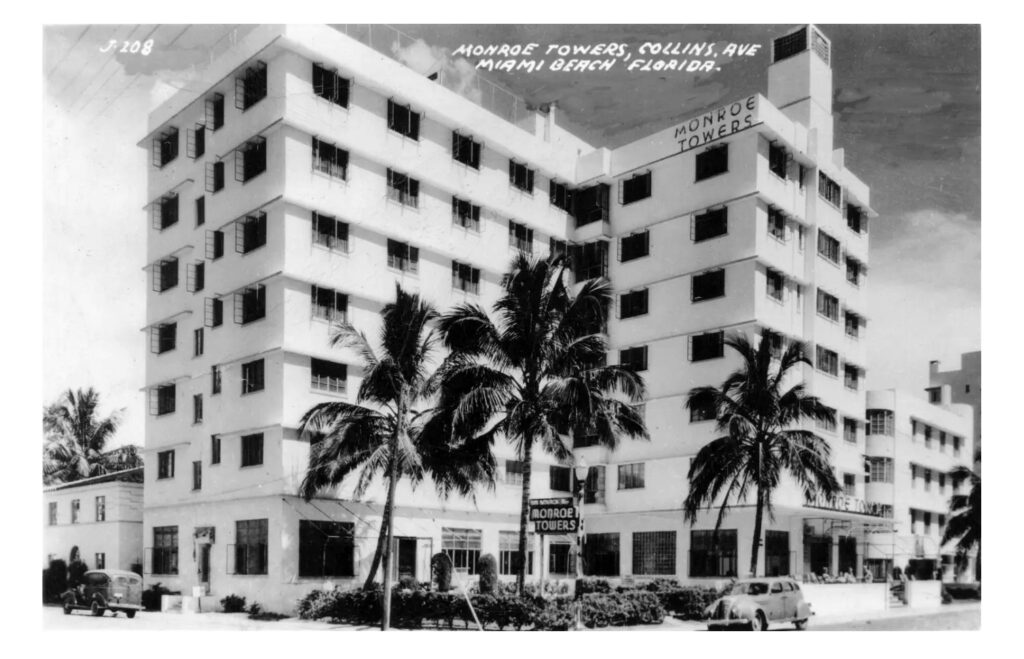
Top photo: The building at 3010 Collins Ave., then the Monroe Towers, on a 1945 postcard. Photo: unknown author, public domain, via Wikimedia Commons.
An old building with a new plan
The Monroe sits at 3010 Collins Ave. in Miami Beach’s Faena District, according to a September announcement from Marcus & Millichap. The address is an old one in the city’s hotel story. It went up in 1935 as the Monroe Towers, an Art Deco building that is listed among the contributing properties of Miami Beach’s Collins Waterfront Architectural District. It is also a different hotel from the Freehand Miami, the 89-key Miami Beach property that Playboy has separately agreed to acquire, a deal we covered here.
When the work is done, the five-star boutique hotel will have 89 rooms, a full-service beach club, a pool, a spa, community space, a recording studio and a 120-seat indoor-outdoor restaurant with a rooftop bar, Nuveen Green Capital said. Marcus & Millichap’s release fills in more of the picture: 15 suites ranging from 488-square-foot junior suites to a 1,257-square-foot presidential suite, a 5,000-square-foot full-service restaurant and bar, an in-house recording studio, private beach service through Boucher Brothers, and a full-service spa and fitness center. The hotel is scheduled to open in 2027. The total project cost is $125.5 million.
The Florida Development Finance Corp. put the public purpose plainly. “This financing will help transform a historic property into a boutique hotel, supporting investment in Miami Beach’s tourism economy and creating new opportunities for local businesses,” FDFC said, as quoted by Hotelrealtor.biz.
Four checks, one hotel
The C-PACE loan did not arrive alone. In September, IPA Capital Markets, a division of Marcus & Millichap, announced that it had arranged a $75.1 million mid-construction recapitalization of The Monroe on behalf of the ownership group. Managing director Bobby Werhane led the transaction, with support from senior director Scott Raasch, both of the firm’s Charlotte office. The stack had four pieces: the $44 million in C-PACE from Nuveen Green Capital, $24.8 million in construction debt from City National Bank, $6.3 million in bridge financing from Midland States Bank, and historic tax credit equity financing from PNC Bank.
“This was a complex, multisource recapitalization, and completing it required creativity and strong relationships across the capital stack,” Werhane said in the release.
Run the numbers and the C-PACE piece is the largest single check in that recapitalization, more than half of the $75.1 million, and about 35% of the hotel’s $125.5 million total cost. That is not a green-energy side loan for a few rooftop panels. That is a structural beam in the capital stack.
There was one more detail that mattered. The financing could be drawn in tranches to match construction disbursements, Nuveen Green Capital said, which let the developer meet its funding needs while reducing interest expense. Money that has not been drawn yet is money that is not yet costing interest. Nuveen Green Capital’s deal team on the closing was Ryan Doyle, Brendan Moore and Cameron Chavira.
How C-PACE actually works
C-PACE stands for Commercial Property Assessed Clean Energy, and the name undersells it. It is not a mortgage. According to the C-PACE Alliance, the money comes from private capital providers, the financing is secured with a lien on the property, and the owner repays it in installments as a line item on the property tax bill, collected through the normal tax process, with the tax authorities forwarding the payments to the capital provider. The assessment can be prepaid.
It has also grown up. C-PACE policies now exist in 40 states with more than 32 active programs, law firm Mayer Brown wrote in June, and the average C-PACE financing has grown from about $800,000 in 2017 to $40 million in 2026. The firm pointed to the C-PACE financing of the Rio Hotel & Casino in Las Vegas, which reached north of $175 million.
In Florida, the rules for commercial properties are in section 163.082 of the Florida Statutes. A county or city authorizes a program administrator by ordinance or resolution, and that administrator can levy non-ad valorem assessments to repay financing for qualifying improvements. Once the agreement is recorded, the assessment is a lien “of equal dignity to county taxes and assessments.” Here is the part lenders care about most: the lien cannot be enforced in a way that accelerates the remaining balance that is not yet delinquent. The financing term cannot exceed the weighted average useful life of the improvements, and it is capped at 30 years.
FDFC is the state’s conduit. It provides access to C-PACE through revenue notes and finance agreements, and it works with the Florida Resiliency and Energy District, or FRED, an entity created by an interlocal agreement between Fernandina Beach and Lake Clarke Shores, which levies and collects the assessment through the local tax collector. Communities join FRED by resolution. On the owner’s tax bill, the payment shows up in the non-ad valorem section as “PACE Assessment” or “Florida Resiliency and Energy District.” Nuveen Green Capital is on FDFC’s list of active capital providers.
Who qualifies, and what it pays for
Florida’s definitions treat commercial property as anything other than residential, including real property used for commercial purposes and multifamily buildings of five or more units. The improvements that qualify are spelled out: energy efficiency work such as heating, cooling and ventilation, insulation, windows, efficient lighting, energy controls and EV charging; renewable energy; water conservation; waste and sewer systems; and resiliency work such as roofs, wind hardening and flood mitigation. FDFC’s list of typical measures includes HVAC, elevators, flood mitigation, lighting, solar, water fixtures, building envelope, and roofing and insulation.
Before the money moves, the statute requires the program administrator to find that there are enough resources to finish the project, that property taxes and assessments are current, that there are no involuntary liens over $5,000, that no notices of default have been recorded in the past three years (or the owner’s period of ownership, if shorter), that the owner is current on all mortgage debt, and that the owner is not in bankruptcy.



Comments
No comments yet. Start the conversation.