Agoda Joins Meta’s Muse AI Agent: Will Hotels Pay a Second Cut?
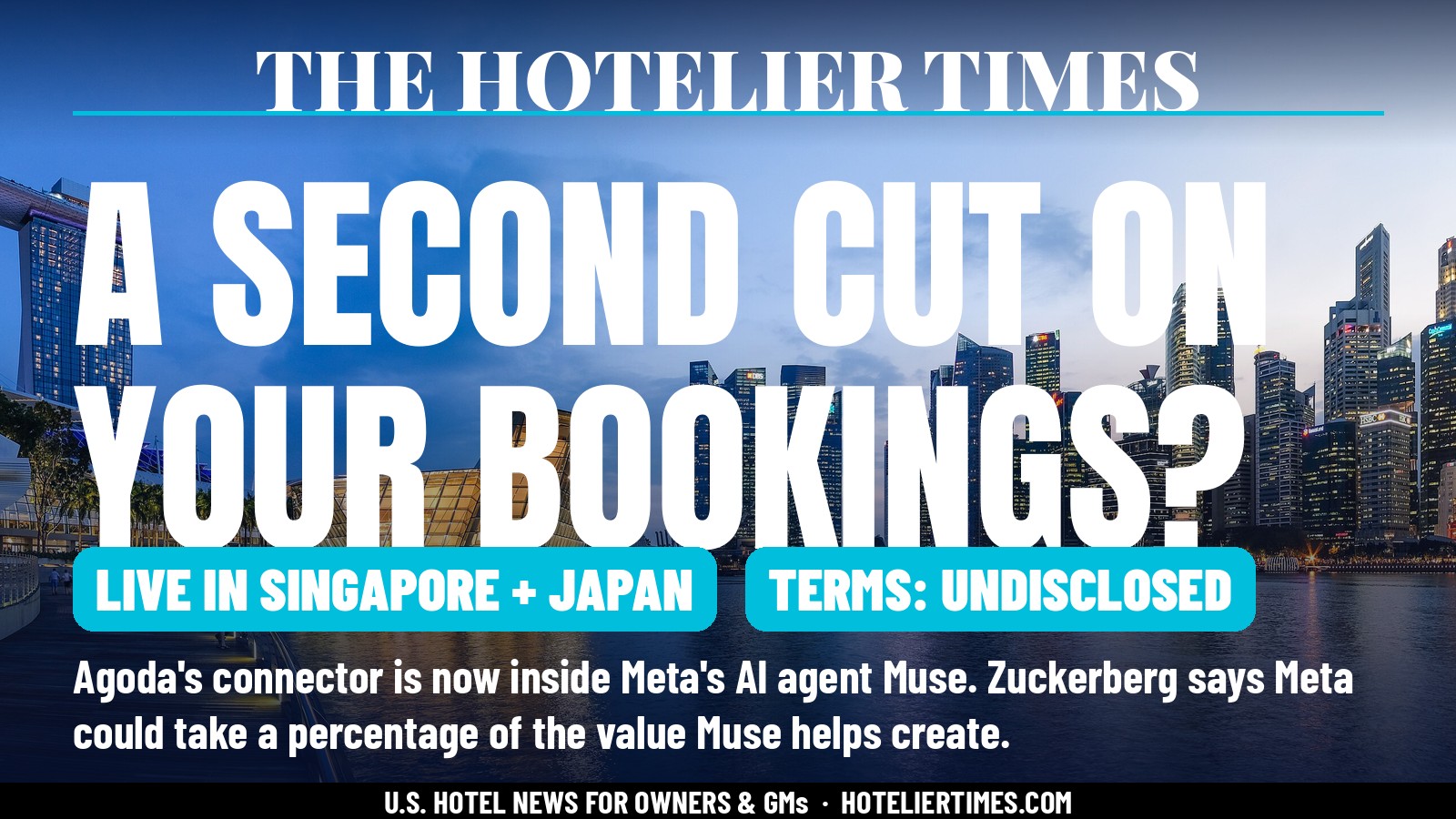
What’s new: Agoda is live as a connector inside Meta’s Muse AI agent in Singapore and Japan as of Oct. 28. That puts Booking Holdings next to Expedia’s earlier Muse foothold in North America. Meta CEO Mark Zuckerberg has said Meta expects “a percent of the value” Muse helps create, paid by businesses — but commercial terms for Agoda–Muse bookings were not disclosed, and the idea of a cut “on top of” OTA commissions is analysis, not Zuckerberg’s wording.
This is a follow-up to our earlier piece, The Agent Will See You Now, which covered Cloudbeds’ planned Muse path for U.S. hotels, Booking’s Vayo bet and Expedia’s faster onboarding. The Oct. 28 Agoda move is the new fact: Booking Holdings’ Asia-focused OTA is now inside Muse in two live markets, with hotel discovery and booking in the agent’s conversation flow.
What Agoda Announced
In an Oct. 28 PR Newswire release, Agoda said it is “now available as a connector in Muse,” Meta’s personal AI agent, and that Muse launched in Singapore that day. Agoda called itself “the first travel platform regionally with an active Muse connector.” The connector links Agoda’s AI travel assistant to Muse so users can “discover destinations, book hotels, and manage itineraries directly with Agoda.” It is available to Muse users in Singapore and Japan via the Muse app on iOS and Android and at muse.ai.
Matteo Frigerio, Agoda’s chief product officer, said the connection “gives travelers another convenient way to discover, plan and book their trips.” Nicole Tan, managing director, Meta Singapore, said users “choose what it can access and approve actions before they happen.” Neither statement disclosed commissions, Meta fees or merchant-of-record rules.

Where This Sits Against Expedia and Cloudbeds
Skift reported that Agoda’s Muse debut comes about a month after Expedia joined Muse at the U.S. launch, and that Meta has identified Expedia as a hotel booking partner in that market (Skift, Oct. 28). Skift’s key points also say Muse in Singapore books through direct connectors from launch — a change from North America, where it initially navigated Expedia and Hotels.com through a browser. Treat that connector/browser distinction as Skift-reported.
Separately, Cloudbeds said Oct. 20 it will connect participating hotels to Muse with live rates, completing the booking in the hotel’s own Cloudbeds Booking Engine as a direct reservation, with a U.S. rollout planned for Q1 2027. That is the contrasting owner path we flagged in The Agent Will See You Now: an OTA connector versus a direct PMS/booking-engine path. Cloudbeds has not disclosed what it will charge for the Muse link.
What Zuckerberg Actually Said
On Meta’s Q3 2026 earnings call (Oct. 21), Mark Zuckerberg described Muse’s business model in prepared remarks: “For most people, the product should be free and we will build commerce tools so we get paid a fee based on the transactions that we help facilitate. We expect this will be paid for by businesses.”
In Q&A, asked about monetization and whether commerce includes travel, Zuckerberg said travel is “one of the other top use cases for Muse,” and: “I think we will be able to build a model where we get a percent of the value that we are helping to create for people.” He did not disclose a percentage rate, a travel-specific fee schedule, or any statement that Meta would take a fee stacked on top of OTA commissions.
Meta’s own usage color from the same Oct. 21 call: more than 10 million people in the U.S. and Canada had set up Muse personal agents in about a month and a half, about 25% of those people use Muse on a given day, and shopping is the most common use case, with average purchase size over $200 — a figure Zuckerberg’s Q&A treated as including travel. Those are Meta’s adoption metrics, not hotel booking counts. They do show why Meta is talking about monetizing commerce sooner than its usual product playbook.
Skift’s Agoda story frames the open economics question for hotels: if Meta is paid and the OTA still takes commission, owners could face a higher effective distribution cost. That “second cut” framing is Skift’s analysis, not Zuckerberg’s words. Commercial terms for the Agoda–Muse connector were not disclosed; Skift reported that Agoda declined to comment when asked.
Why U.S. Owners Should Care Now
Agoda’s live markets are Singapore and Japan, not the U.S. Your near-term Muse exposure, if any, still runs through Expedia (and later Cloudbeds for some independents). The reason to watch Agoda is distribution architecture: Booking Holdings now has a regional Muse connector, Expedia holds the North America hotel slot Skift describes, and Meta has said aloud that it wants a percentage of value from commerce including travel.
Booking Holdings CEO Glenn Fogel told Skift Global Forum in September that traffic from large language models was still “significantly below 1%” of Booking.com room nights — useful context that agent volume is early, even as connectors multiply (Skift, Sept. 23).
For you, the practical risk is not that Muse is already filling your U.S. hotel tonight. It is that the fee stack for agent bookings could be set while volume is still small — and that OTA connectors and direct connectors may price the same guest differently. Also see our related coverage on Expedia and rate parity, AI tools owners are testing, and HITEC 2026.
What Is Still Undisclosed
- Any Meta take rate on Agoda, Expedia or Cloudbeds Muse bookings.
- Who pays Meta in an OTA-mediated Muse booking (OTA, hotel, or shared).
- Merchant of record and cancellation handling for Agoda-via-Muse bookings.
- Whether Booking.com or other Booking Holdings brands get Muse connectors in other markets.

What This Means for Your Hotel
Full Access Pass
Keep reading
Get the rest of this article for 99¢ with a 24-hour Day Pass, or get the Full Access Pass for $1.99/month for every article.



Comments
No comments yet. Start the conversation.