A Sub-5% 10-Year, 3.6% Inflation and $116 Oil: What This Week’s Numbers Mean for Your Hotel Loan
By Nathan Snyder, Editor, The Hotelier Times
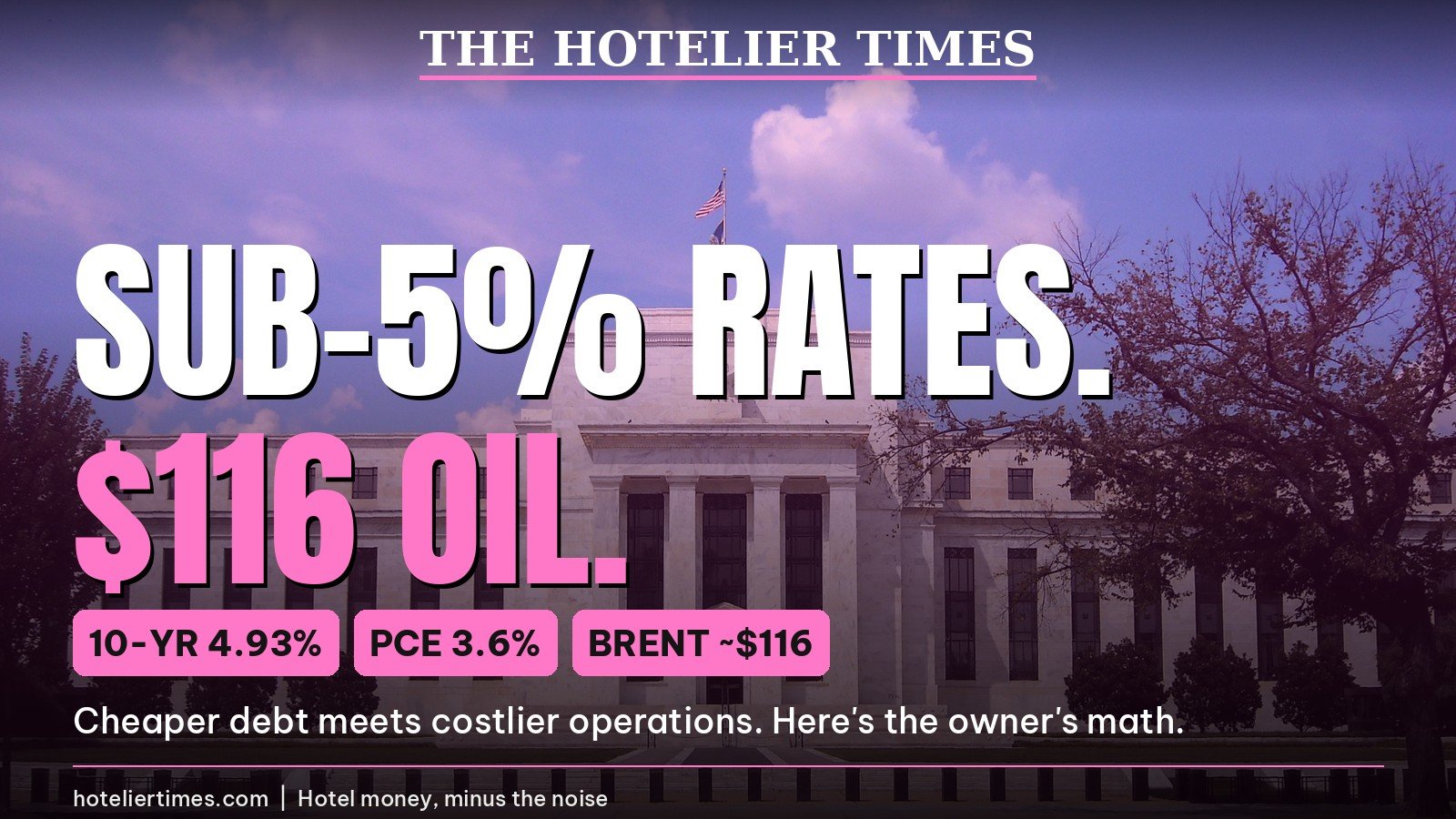
The 10-year Treasury printed 4.933% early Friday (CNBC, 4:09 a.m. ET). InvestingLive, summarizing Reuters, earlier put the note near 4.90% at a more-than-one-month low. September PCE came in at 3.6% year over year (3.1% core). Brent held near $116–$118 on Middle East supply risk. For hotel owners staring at a 2026–27 maturity, that combination reopens the fixed-rate versus SOFR-floater debate — without clearing the inflation or oil overhang.
CNBC’s overnight markets wrap, published at 4:09 a.m. ET on Oct. 30, 2026, put the U.S. 10-year yield at 4.933%. InvestingLive’s earlier summary of Reuters had the 10-year around 4.90% and framed the move as a more-than-one-month low — wording that does not appear in the CNBC print cited for the 4.933% level. Overnight SOFR, the floating-rate loan benchmark, last printed 3.94% for Oct. 28, according to the New York Fed.
Thursday’s Commerce Department package is the other half of the tape. The Bureau of Economic Analysis’s advance estimate showed real GDP rising at a 3.4% annualized pace in the third quarter. September’s personal consumption expenditures price index — the Fed’s preferred inflation gauge — rose 3.6% year over year, with core PCE at 3.1%, per BEA. Growth is fine. The inflation print is not back at 2%.
Oil Near $116 Keeps the Inflation Wildcard Alive
Brent stayed elevated on Middle East supply risk. Reuters and CNBC both had December Brent futures above $117 Friday morning after an earlier print near $116.60, citing a tanker attack in the Strait of Hormuz and broader Iran-related disruption fears. We covered what a six-month oil high does to drive-in demand and your energy line in our $116 Brent piece. The rate rally and the oil spike are not the same trade — and oil is the one that can unwind a bond bid if it sticks.
The Federal Reserve held the funds rate in a 3.75%–4% target range this week. Markets continued to price a meaningful chance of a December hike after the hold; CME FedWatch showed a 71.4% probability of a 25-basis-point increase as of Friday morning Oct. 30, according to Yahoo Finance. Those odds move intraday, and a hike market is not a cut market. Our earlier owner checklist after the hold is here.
What the Spreads Still Say About Hotel Debt
A sub-5% 10-year does not mean your hotel loan clears at 5%. Bank of America’s CMBS Weekly, as summarized by Finvaulta for the week of Oct. 23, put on-the-run conduit LCF AAA near T+85 (5-year) and T+80 (10-year) as of Oct. 22 — a few basis points wider at the top of the stack that week. Trepp’s June 22, 2026 analysis of 2026 conduit originations still showed lodging as the widest major property type: a median five-year lodging conduit loan spread around 319 bp versus roughly 270 bp for all property types. Hotels pay a spread premium even when Treasuries cooperate.
Maturity pressure has not left the building. Trepp’s Oct. 6 note on October hard maturities flagged $4.70 billion in private-label CMBS coming due that month, with hospitality about $550 million of the cohort and most of that hospitality balance showing debt yields under 6%. CRED iQ’s Oct. 29 metro/property-type distress update put national conduit-plus-SASB distress at 11.2% of a $617 billion universe and lodging distress at 9.9%, with about $1.1 billion of hotel debt newly delinquent or newly in special servicing in October — including a large select-service portfolio loan transferred ahead of a December maturity. That is the backdrop against which a 4.93% 10-year has to be read.
Fixed CMBS Takeout vs. a SOFR Floater
For an owner comparing a fixed takeout to a floating note, the arithmetic is rough but useful. Fixed all-in is approximately the 10-year Treasury plus your CMBS or bank spread (plus fees). A floater is roughly SOFR plus lender margin, with caps and floors if you bought them. With SOFR near 3.9% and the 10-year near 4.9%, a tight-margin floater can look cheaper on day-one coupon — but sticky PCE at 3.6% and a market that is still pricing hike risk into December raise the odds that SOFR resets higher. Conversely, if the bond rally holds and AAA and loan spreads stay contained near the low-80s over Treasuries that BofA showed in late October, fixed CMBS takeout math improves. None of those are rate quotes or a recommendation; they are the comparison your lender already runs.
PeerSense’s Oct. 27 tracker still showed indicative hotel CMBS quotes roughly in the high-6% to mid-8% area on one aggregator board — secondary ranges, not a commitment. Dallas pipeline financing still leans on the same Treasury tape; see our Dallas pipeline update. The maturity wall in The Refi Clock has not gone away because the 10-year printed a four-handle overnight.
The Labor Department’s third-quarter Employment Cost Index, released at 7:30 a.m. CT Friday, showed civilian-worker compensation up 0.8% for the quarter and 3.4% over 12 months (unchanged). Wages and salaries rose 0.7% quarter over quarter and 3.1% year over year; benefits rose 0.9% and 3.9%, respectively, with private health benefits up 6.4% year over year. Accommodation and food services — the series includes restaurants, not hotels alone — posted wage growth of 2.1% year over year (compensation +2.4%), below the economy-wide 3.1% wage pace and down from 2.3% in June. Wage pressure in the sector that includes hotels is cooling; benefits, especially health, remain the sticky cost line for 2027 budgets.
What This Means for Your Hotel…
Full Access Pass
Continue reading
Get the rest of this article for 99¢ with a 24-hour Day Pass, or get the Full Access Pass for $1.99/month for every article.


Comments
No comments yet. Start the conversation.